9.10.7
Practice
9.10.7 • Practice
Complete the following questions to practice the skills you have learned in this lesson.
- The following quadratic expressions all define the same function.
Select three statements that are true about the graph of this function.
- The -intercept is .
- The vertex is .
- The -intercepts are and .
- The -intercepts are and .
- The -intercept is .
- The -intercept is .
- The vertex is .
- The following expressions all define the same quadratic function.
- What is the value of the -coordinate of the -intercept of the graph of the function?
- Select two -intercepts of the graph.
- What is the -coordinate of the vertex of the graph?
- What is the -coordinate of the vertex of the graph?
- Is this an accurate graph of the function?
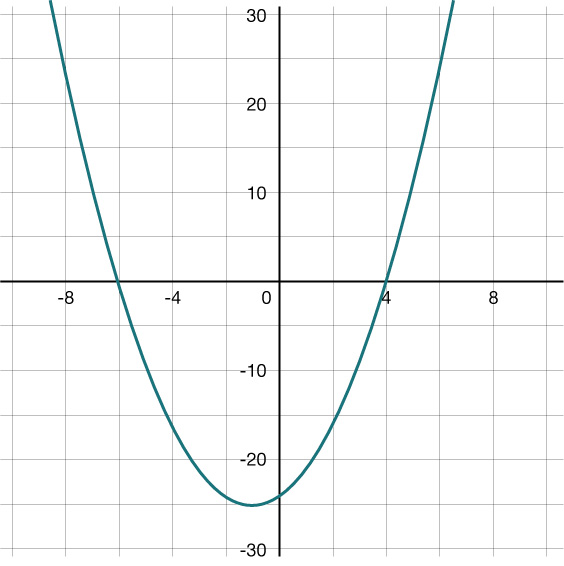
-
No
-
Yes
- Here is one way an expression in standard form is rewritten into vertex form.
Original expression
Step 1 -
Step 2 -
Step 3 -
Step 4 -
- In Step 1, where did the number come from?
-
Only the non-linear term was divided by 2.
-
It is half of -7 being squared.
-
Every term in the expression was divided by 2.
-
It is the substitute value for .
- In Step 1, why was added and then subtracted?
-
It is subtracted to complete the square. It is added to change the value of the expression.
-
It is added to complete the square. It is subtracted to change the value of the expression.
-
It is subtracted to complete the square. It is added to keep the value of the expression unchanged.
-
It is added to complete the square. It is subtracted to keep the value of the expression unchanged.
-
The expression is added to keep the value of the expression unchanged.
-
The expression, which is not a perfect square, is written as a squared expression.
-
The expression, which is a perfect square, is written as a squared expression.
-
The expression is subtracted to keep the value of the expression unchanged.
-
The constant term is written as a fraction so that it has a common denominator, which makes it easier to subtract.
-
The linear term is written as a fraction so that it has a common denominator, which makes it easier to subtract.
-
A random term was added to complete the square.
-
The quadratic term is written as a fraction so that it has a common denominator, which makes it easier to subtract.
- What does the last expression tell us about the vertex of the graph of a function defined by this expression?
-
The vertex of the graph is at .
-
The vertex of the graph is at .
-
The vertex of the graph is at .
-
The vertex of the graph is at .
- Enter the missing number, including the sign, for the expression when is written in vertex form.
.
- Enter the missing numbers, including the signs, for the expression when is written in vertex form.
- What is the value of the missing number, including the sign, in the place of the letter a?
- What is the value of the missing number, including the sign, for the letter b?
- Enter the missing numbers, including the signs, for the expression when is written in vertex form.
- What is the value of the missing number, including the sign, in place of letter a?
- What is the value of the missing number, including the sign, in place of letter b?
- What is the value of the missing number, including the sign, in place of letter c?
- Enter the missing numbers, including the signs, for the expression when is expanded to standard form.
- What is the value of the missing number, including the sign, in place of letter a?
- What is the value of the missing number, including the sign, in place of letter b?
- What is the value of the missing number, including the sign, in place of letter c?