5.4.6
Practice
5.4.6 • Practice
Complete the following questions to practice the skills you have learned in this lesson.
- Which expression is equal to ?
-
64
-
16
-
1
-
0
- Select three expressions that are equivalent to .
For 3 – 8 use the following information and table:
An investment bond is initially bought for $250. It doubles in value every decade. For each of the missing spaces in the table, complete the table.
|
decades since bond is bought
|
dollar value of bond
|
|
0
|
3. _____
|
|
1
|
4. _____
|
|
2
|
5. _____
|
|
3
|
6. _____
|
- The dollar value of the bond, 0 decades
-
$750
-
$500
-
$250
-
$0
- The dollar value of the bond, 1 decade
-
$1000
-
$750
-
$500
-
$250
-
$0
- The dollar value of the bond, 2 decades
-
$1500
-
$1250
-
$1000
-
$750
-
$500
- The dollar value of the bond, 3 decades
-
$2250
-
$2000
-
$1750
-
$1500
-
$1250
-
$1000
- How many decades does it take before the bond is worth more than $10,000?
- Choose an equation that relates , the value of the bond, to , the number of decades since the bond was bought.
-
-
-
-
For questions 9 – 10, use the following information:
A sea turtle population is modeled by the equation where is the number of years since the population was first measured.
- How many turtles are in the population when it is first measured?
- After how many years will the turtle population reach 700? Round to the nearest full year.
Use the following information to answer questions 11 and 12.
- Bank Account A starts with $5,000 and grows by $1,000 each week.
- Bank Account B starts with $1 and doubles each week
- Which account has more money after one week?
-
Bank Account A
-
Bank Account B
- Which account has more money after fifteen weeks?
-
Bank Account A
-
Bank Account B
For 13 - 15, use this graph showing the two account balances.
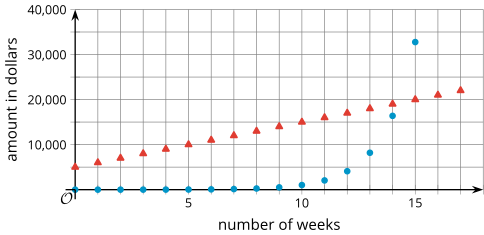
- The graph of the red triangles corresponds to which bank account?
-
Bank Account A
-
Bank Account B
- The graph of the blue circles corresponds to which bank account?
-
Bank Account A
-
Bank Account B
- Which of the two accounts would you choose for long-term saving?
-
Bank Account A
-
Bank Account B