7.10.5
Practice
7.10.5 • Practice
Complete the following questions to practice the skills you have learned in this lesson.
- A quadratic function is defined by .
- Without graphing, identify the -intercepts of the graph of .
-
-
-
-
- Use the standard form of to identify the -value of the -intercept of the graph of .
- Answer these questions for the equation .
- What is the -value of the -intercept of this equation’s graph?
- An equivalent way to write this equation is . What are the -intercepts of this equation’s graph?
-
-
-
-
- Noah said that if we graph , the -intercepts will be at and . Is Noah correct?
-
Yes
-
No
- Select two -intercepts of this graph.
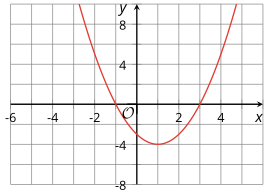
- Use the standard form of to identify the -value of the -intercept of the graph.