Reasoning Symbolically and Abstractly about Linear Equations

1.11.3 Reasoning Symbolically and Abstractly about Linear Equations

1.11.3 • Reasoning Symbolically and Abstractly about Linear Equations

Activity

For questions 1 – 5, select the slope and intercept that corresponds to each equation:

1.

− 4 x + 3 y = 3 − 4 x + 3 y = 3

  1. m = 3 m = 3 , y -int = ( 0 , 1 ) y -int = ( 0 , 1 )

  2. m = 4 3 m = 4 3 , y -int = ( 0 , 1 ) y -int = ( 0 , 1 )

  3. m = 4 3 m = 4 3 , y -int = ( 0 , − 2 ) y -int = ( 0 , − 2 )

  4. m = − 4 m = − 4 , y -int = ( 0 , 8 ) y -int = ( 0 , 8 )

  5. m = 3 m = 3 , y -int = ( 0 , − 2 ) y -int = ( 0 , − 2 )

m = 4 3 m = 4 3 , y -int = ( 0 , 1 ) y -int = ( 0 , 1 )

2.

12 x − 4 y = 8 12 x − 4 y = 8

  1. m = 3 m = 3 , y -int = ( 0 , 1 ) y -int = ( 0 , 1 )

  2. m = 4 3 m = 4 3 , y -int = ( 0 , 1 ) y -int = ( 0 , 1 )

  3. m = 4 3 m = 4 3 , y -int = ( 0 , − 2 ) y -int = ( 0 , − 2 )

  4. m = − 4 m = − 4 , y -int = ( 0 , 8 ) y -int = ( 0 , 8 )

  5. m = 3 m = 3 , y -int = ( 0 , − 2 ) y -int = ( 0 , − 2 )

m = 3 m = 3 , y -int = ( 0 , − 2 ) y -int = ( 0 , − 2 )

3.

8 x + 2 y = 16 8 x + 2 y = 16

  1. m = 3 m = 3 , y -int = ( 0 , 1 ) y -int = ( 0 , 1 )

  2. m = 4 3 m = 4 3 , y -int = ( 0 , 1 ) y -int = ( 0 , 1 )

  3. m = 4 3 m = 4 3 , y -int = ( 0 , − 2 ) y -int = ( 0 , − 2 )

  4. m = − 4 m = − 4 , y -int = ( 0 , 8 ) y -int = ( 0 , 8 )

  5. m = 3 m = 3 , y -int = ( 0 , − 2 ) y -int = ( 0 , − 2 )

m = − 4 m = − 4 , y -int = ( 0 , 8 ) y -int = ( 0 , 8 )

4.

− x + 1 3 y = 1 3 − x + 1 3 y = 1 3

  1. m = 3 , y -int = ( 0 , 1 ) m = 3 , y -int = ( 0 , 1 )

  2. m = 4 3 m = 4 3 , y -int = ( 0 , 1 ) y -int = ( 0 , 1 )

  3. m = 4 3 m = 4 3 , y -int = ( 0 , − 2 ) y -int = ( 0 , − 2 )

  4. m = − 4 m = − 4 , y -int = ( 0 , 8 ) y -int = ( 0 , 8 )

  5. m = 3 m = 3 , y -int = ( 0 , − 2 ) y -int = ( 0 , − 2 )

( m=3 \), y -int = ( 0 , 1 ) y -int = ( 0 , 1 )

5.

− 4 x + 3 y = − 6 − 4 x + 3 y = − 6

  1. m = 3 m = 3 , y -int = ( 0 , 1 ) y -int = ( 0 , 1 )

  2. m = 4 3 m = 4 3 , y -int = ( 0 , 1 ) y -int = ( 0 , 1 )

  3. m = 4 3 m = 4 3 , y -int = ( 0 , − 2 ) y -int = ( 0 , − 2 )

  4. m = − 4 m = − 4 , y -int = ( 0 , 8 ) y -int = ( 0 , 8 )

  5. m = 3 m = 3 , y -int = ( 0 , − 2 ) y -int = ( 0 , − 2 )

m = 4 3 m = 4 3 , y -int = ( 0 , − 2 ) y -int = ( 0 , − 2 )

Using Standard Form and Intercepts to Graph

Standard form, A x + B y = C A x + B y = C , is helpful for finding the x x -intercepts and y y -intercepts of an equation.

For questions 6 – 11, use the equation 6 x − 4 y = 24 6 x − 4 y = 24 .

6.

What is the value of y y at the x x -intercept?

0

7.

What is the x x -intercept of the equation?

4

8.

What is the value of x x at the y y -intercept?

0

9.

What is the y y -intercept of the equation?

-6

10.

Use the graphing tool or technology outside the course. Plot the two intercepts and the equation of the line, using the Desmos tool below.
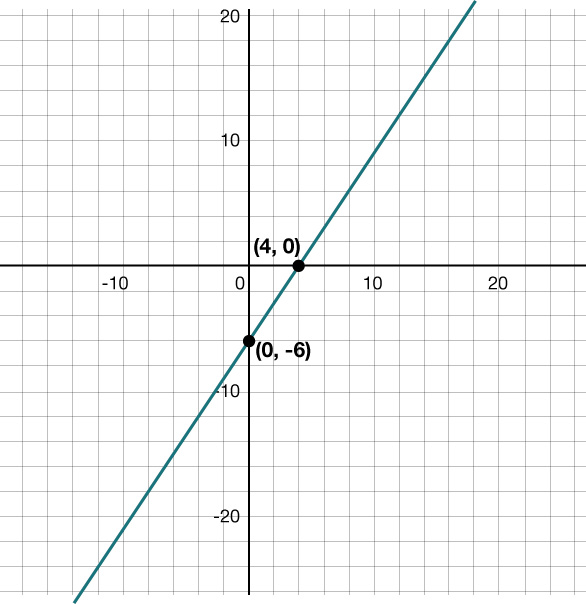
Plot of two intercepts, four comma zero and zero comma negative six for the equation of the line.

Compare your answer:

11.

Using the graph from question 10, what is the slope of the line in simplest form?

Compare your answer:

3 2 3 2

Are you ready for more?

Extending Your Thinking

For questions 1-2, use the equations below:

These are the equations from the activity. Each equation is in the form A x + B y = C A x + B y = C .
4 x − 3 y = − 3 4 x − 3 y = − 3
12 x − 4 y = 8 12 x − 4 y = 8
8 x + 2 y = 16 8 x + 2 y = 16
3 x − y = − 1 3 x − y = − 1
4 x − 3 y = 6 4 x − 3 y = 6
1.

Observe the graph of the equation − 4 x + 3 y = 3 − 4 x + 3 y = 3 where it is graphed, on the same coordinate plane, with another line passing through ( 0 , 0 ) ( 0 , 0 ) and ( A , B ) ( A , B ) . In this example A = − 4 A = − 4 and B = 3 B = 3 , so the other line would pass through ( 0 , 0 ) ( 0 , 0 ) and ( − 4 , 3 ) ( − 4 , 3 ) . What do you notice about the lines?

Compare your answer:

Answers may vary, but here is a sample. The two lines are perpendicular.
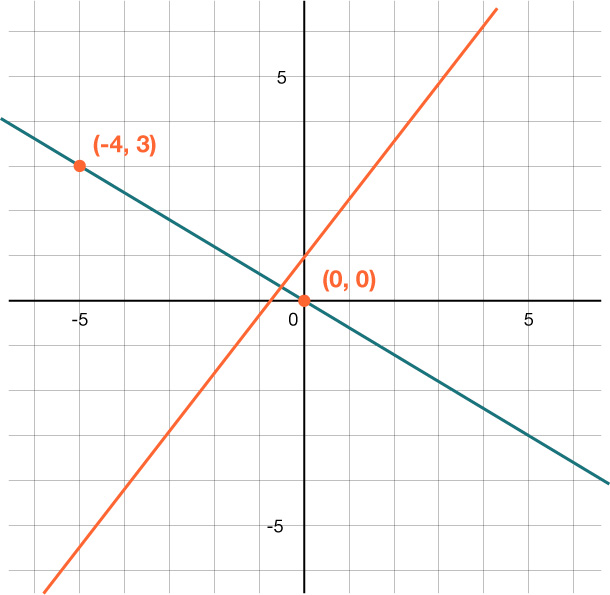
Graph with two intersecting lines. One line passes through points (0, 0) and (-4, 3); the other, steeper line Intersects the first line. Both axes are labeled, and gridlines are visible.
2.

Use the graphing tool or technology outside the course. Graph the equation that represents this scenario using the Desmos tool above. Then make another observation about the lines.

Compare your answer:

Answers may vary, but here is a sample.The two lines are always perpendicular.

Graph with two intersecting lines. One line passes through points (0, 0) and (-4, 3); the other, steeper line Intersects the first line. Both axes are labeled, and gridlines are visible.

Self Check

What is the slope of the line 4 x + 3 y = 12 ?
  1. 4 3
  2. − 3 4
  3. 3 4
  4. − 4 3

Additional Resources

Video: Using Standard Form

Watch the following video to learn more about using standard form to find slope and y y -intercepts.

Try it

Using Standard Form

1.

Find the slope for 5 x − y = 15 5 x − y = 15 .

5

2.

Find the y y -intercept for 5 x − y = 15 5 x − y = 15 .

-15

3.

Explain your reasoning.

Compare your answer:

Strategy 1: Solve for y y .

Step 1 - Subtract the x x term from both sides.

Subtract 5 5 from both sides.

5 x − 5 x − y = 15 − 5 x 5 x − 5 x − y = 15 − 5 x

Step 2 - Simplify.

− y = 15 − 5 x − y = 15 − 5 x

Step 3 - Divide both sides by the coefficient of y y .

Divide both sides by − 1 − 1 .

− y − 1 = 15   − 5 x − 1 − y − 1 = 15   − 5 x − 1

Step 4 - Simplify.

y = 5 x − 15 y = 5 x − 15

The slope is the coefficient of x x , so the slope is 5. The y y -intercept is the constant, which is −15.

Strategy 2: Use standard form.

Step 1 - Identify A, B, and C.

In 5 x − y = 15 5 x − y = 15 , A = 5 A = 5 , B = − 1 B = − 1 , C = 15 C = 15 .

Slope: − A B = − 5 − 1 = 5 − A B = − 5 − 1 = 5

y y -intercept: C B = 15 − 1 = − 15 C B = 15 − 1 = − 15