5.9.6
Practice
5.9.6 • Practice
Complete the following questions to practice the skills you have learned in this lesson.
- The number of people with the flu during an epidemic is a function, , of the number of days, , since the epidemic began. The equation defines .
- How many people had the flu at the beginning of the epidemic?
- What does mean in this situation?
-
The number of people infected after 1 year.
-
The number of people infected grows by a factor of 1.
-
The number of people infected 1 day after the epidemic began.
-
There was 1 year of the epidemic.
- The function, , gives the dollar value of a bond years after the bond was purchased. The graph of is shown.
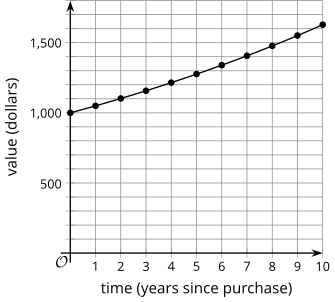
- What is ?
- When is ? Estimate to the nearest whole number.
- A function gives the number of stray cats in a town years since the town started an animal control program. The program includes both sterilizing stray cats and finding homes to adopt them. An equation representing is .
- What is the value of when is 0?
- What is the value of when is 1?
- Function gives the amount of a chemical in a person’s body, in milligrams, hours since the patient took the drug. The equation defines this function.
- Which is the best choice for the domain of ?
-
-
-
-
- Which is the best choice for the range of ?
-
-
-
-