Practice

9.1.5 Practice

9.1.5 • Practice

Complete the following questions to practice the skills you have learned in this lesson.

  1. Select three expressions that are perfect squares.
  1. ( x + 5 ) ( x + 5 )
  2. ( − 9 + c ) ( c − 9 )
  3. ( y − 10 ) ( 10 − y )
  4. ( 2 x − 1 ) ( 2 x + 1 )
  5. ( 4 − 3 x ) ( 3 − 4 x )
  6. ( a + b ) ( b + a )
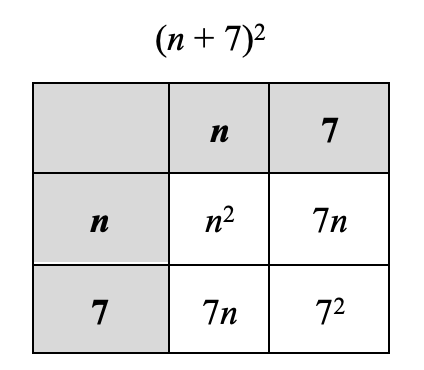
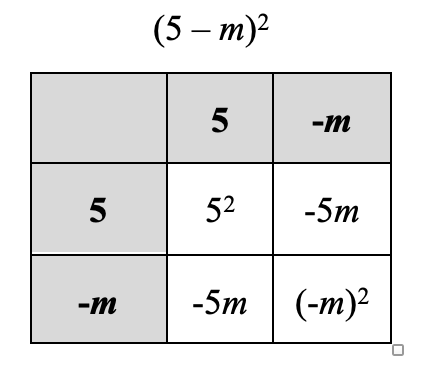
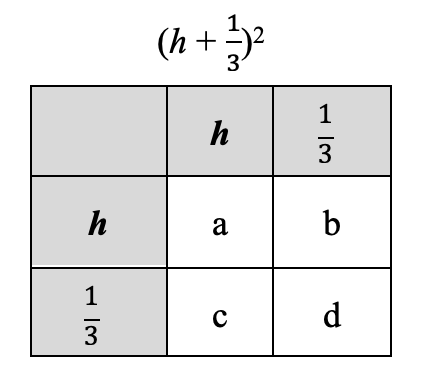
  1. Each diagram represents the square of an expression or a perfect square. Complete the cells in the last table by answering questions a–d.
Diagram 1 Diagram 2 Diagram 3
  1. What is the answer for Cell a in Diagram 3?
  1. ( 1 3 ) 2
  2. ( 1 3 h ) 2
  3. h 2
  4. 1 3 h
  1. What is the answer for Cell b in Diagram 3?
  1. ( 1 3 ) 2
  2. ( 1 3 h ) 2
  3. h 2
  4. 1 3 h
  1. What is the answer for Cell c in Diagram 3?
  1. ( 1 3 ) 2
  2. ( 1 3 h ) 2
  3. h 2
  4. 1 3 h
  1. What is the answer for Cell d in Diagram 3?
  1. ( 1 3 ) 2
  2. ( 1 3 h ) 2
  3. h 2
  4. 1 3 h
  1. Rewrite the perfect-square expression ( h + 1 3 ) 2 in standard form a x 2 + b x + c .
  1. h 2 + 1 9 h + 2 3
  2. h 2 + 2 6 h + 2 6
  3. h 2 + 2 3 h + 1 9
  4. 2 h + 2 3 h + 1 9
  1. Rewrite the perfect-square expression ( 5 − m ) 2 in standard form a x 2 + b x + c .
  1. 25 m 2 − 10
  2. m 2 − 10 m + 25
  3. m 2 + 10 m − 25
  4. − 12 m + 10
  1. Rewrite the perfect-square expression ( n + 7 ) 2 in standard form a x 2 + b x + c .
  1. n 2 + 14 n + 49
  2. n 2 + 49 n + 14
  3. n 2 + 14 n + 14
  4. 16 n + 49

For 6 - 9, solve each equation, then choose the two solutions.

  1. ( x − 1 ) 2 = 4
  1. x = − 1
  2. x = 5
  3. x = 2
  4. x = 3
  5. x = 6
  1. ( x + 5 ) 2 = 81
  1. x = 76
  2. x = − 14
  3. x = 86
  4. x = 3
  5. x = 4
  1. ( x + 11 ) 2 = 121
  1. x = 132
  2. x = 110
  3. x = 0
  4. x = − 22
  5. x = 4
  1. ( x − 7 ) 2 = 64 49
  1. x = 2
  2. x = − 279 79
  3. x = 41 7
  4. x = 407 49
  5. x = 57 7
  1. Solve the equation ( x − 2 ) 2 = 0 .