Practice

7.13.6 Practice

7.13.6 • Practice

Complete the following questions to practice the skills you have learned in this lesson.

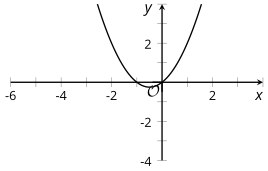
  1. Choose the quadratic equation that represents each graph.
    1. <p>A curve in an x y plane, origin O. Horizontal axis, scale negative 6 to 5, by 1’s. Vertical axis, scale negative 4 to 4, by 1’s. A curve passes through the points negative 2 comma 2, 0 comma 0, and 2 comma 6.</p>

  1. y = x 2 + 3 x
  2. y = x 2 − x
  3. y = − x 2 + 2
  4. y = x 2 + x
    1. <p>A curve in an x y plane, origin O. Horizontal axis, scale negative 6 to 5, by 1’s. Vertical axis, scale negative 4 to 4, by 1’s. A curve passes through the points negative 1 comma 1, 0 comma 0, 2 comma 2.</p>

  1. y = x 2 + 3 x
  2. y = x 2 − x
  3. y = − x 2 + 2
  4. y = x 2 + x
    1. <p>A curve in an x y plane, origin O. Horizontal axis, scale negative 6 to 5, by 1’s. Vertical axis, scale negative 4 to 4, by 1’s. A curve passes through the points negative 1 comma 1, 0 comma 0, 2 comma 2.</p>

  1. y = x 2 + 3 x
  2. y = x 2 − x
  3. y = − x 2 + 2
  4. y = x 2 + x
    1. <p>A curve in an x y plane, origin O. Horizontal axis, scale negative 6 to 5, by 1’s. Vertical axis, scale negative 4 to 4, by 1’s. A curve passes through the points negative 3 comma 3, negative 1 comma negative 2, and 0 comma 0.</p>

  1. y = x 2 + 3 x
  2. y = x 2 − x
  3. y = − x 2 + 2
  4. y = x 2 + x
Without graphing the equations, answer questions 2 – 5 to complete the table.
Equation x -intercepts x -coordinate of vertex
y = x 2 + 12 x 2a. _____ 2b. _____
y = x 2 − 3 x 3a. _____ 3b. _____
y = − x 2 + 16 x 4a. _____ 4b. _____
y = − x 2 − 24 x 5a. _____ 5b. _____
  1. Find the x -intercepts and the x -coordinate of the vertex for the equation y = x 2 + 12 x .
    1. What are the x -intercepts for the equation y = x 2 + 12 x ?
  1. ( 0 , 0 ) , ( − 24 , 0 )
  2. ( 0 , 0 ) , ( 16 , 0 )
  3. ( 0 , 0 ) , ( 3 , 0 )
  4. ( 0 , 0 ) , ( − 12 , 0 )
    1. What is the x -coordinate of the vertex for the equation y = x 2 + 12 x ?
  1. Find the x -intercepts and the x -coordinate of the vertex for the equation y = x 2 − 3 x .
    1. What are the x -intercepts for the equation y = x 2 − 3 x ?
  1. ( 0 , 0 ) , ( − 24 , 0 )
  2. ( 0 , 0 ) , ( 16 , 0 )
  3. ( 0 , 0 ) , ( 3 , 0 )
  4. ( 0 , 0 ) , ( − 12 , 0 )
    1. What is the x -coordinate of the vertex for the equation y = x 2 − 3 x ?
  1. Find the x -intercepts and the x -coordinate of the vertex for the equation y = − x 2 + 16 x .
    1. What are the x -intercepts for the equation y = − x 2 + 16 x ?
  1. ( 0 , 0 ) , ( − 24 , 0 )
  2. ( 0 , 0 ) , ( 16 , 0 )
  3. ( 0 , 0 ) , ( 3 , 0 )
  4. ( 0 , 0 ) , ( − 12 , 0 )
    1. What is the x -coordinate of the vertex for the equation y = − x 2 + 16 x ?
  1. Find the x -intercepts and the x -coordinate of the vertex for the equation y = − x 2 − 24 x .
    1. What are the x -intercepts for the equation y = − x 2 − 24 x ?
  1. ( 0 , 0 ) , ( − 24 , 0 )
  2. ( 0 , 0 ) , ( 16 , 0 )
  3. ( 0 , 0 ) , ( 3 , 0 )
  4. ( 0 , 0 ) , ( − 12 , 0 )
    1. What is the x -coordinate of the vertex for the equation y = − x 2 − 24 x ?
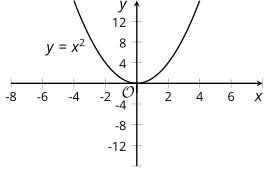
  1. Here is a graph that represents y = x 2 .

     <p>A curve in an x y plane, origin O. Horizontal axis, scale negative 8 to 8, by 2’s. Vertical axis, scale negative 12 to 12, by 2’s. A curve, labeled y equals x squared, passes through the points negative 2 comma 4, 0 comma 0, and 2 comma 4.</p>

  1. Describe what would happen to the graph if the original equation were changed to y = x 2 − 6 x .
  1. The graph would move to the left and up.
  2. The graph would move to the right and up.
  3. The graph would move to the left and down.
  4. The graph would move to the right and down.
    1. Predict the x -intercepts of the graph if the original equation were changed to y = x 2 − 6 x .
  1. ( 0 , 0 ) , ( 0 , − 6 )
  2. ( 0 , 0 ) , ( − 6 , 0 )
  3. ( 0 , 0 ) , ( 0 , 6 )
  4. ( 0 , 0 ) , ( 6 , 0 )
    1. In which quadrant is the vertex located if the original equation were changed to y = x 2 − 6 x ?
  1. First
  2. Second
  3. Third
  4. Fourth
  1. Select two equations whose graph opens upward.
  1. y = − x 2 + 9 x
  2. y = 10 x − 5 x 2
  3. y = ( 2 x − 1 ) 2
  4. y = ( 1 − x ) ( 2 + x )
  5. y = x 2 − 8 x − 7
  1. Technology required. Use the three graphs to answer questions a–c. Then, use graphing technology to check each equation.

Graph A

Parabola. Opens up. X intercepts = 0 and -7.

Graph B

Parabola. Opens up. Vertex = 0 comma -16. X intercepts = -4 and 4.

Graph C

Parabola. Opens up. X intercepts = -9 and 3.
    1. Which graph represents the equation f ( x ) = x ( x + 7 ) or f ( x ) = x 2 + 7 x ? Then, use graphing technology to check your answer.
  1. Graph A
  2. Graph B
  3. Graph C
    1. Which graph represents the equation g ( x ) = ( x + 4 ) ( x − 4 ) or g ( x ) = x 2 − 16 ? Then, use graphing technology to check your answer.
  1. Graph A
  2. Graph B
  3. Graph C
    1. Which graph represents the equation h ( x ) = ( x − 3 ) ( x + 9 ) or h ( x ) = x 2 + 6 x − 27 ? Then, use graphing technology to check your answer.
  1. Graph A
  2. Graph B
  3. Graph C
  1. Choose the quadratic equation written from the real solutions x = − 4 and x = − 3 .
  1. y = x 2 − 7 x − 12
  2. y = x 2 + 7 x − 12
  3. y = x 2 + 7 x + 12
  4. y = x 2 − 7 x + 12