7.14.6
Practice
7.14.6 • Practice
Complete the following questions to practice the skills you have learned in this lesson.
- Here are graphs of functions and .
Each represents the height of an object being launched into the air as a function of time.
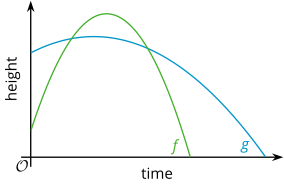
- Which object was launched from a higher point?
-
The object represented by function
-
The object represented by function
- Which object reached a higher point?
-
The object represented by function
-
The object represented by function
- Which object was launched with the greater upward velocity?
-
The object represented by function
-
The object represented by function
- Which object landed last?
-
The object represented by function
-
The object represented by function
- The function given by models the height of a ball in feet, seconds after it was thrown.
- Find one of the zeros of the functions using .
- Find one of the zeros of the functions using .
- What do the zeros tell us in this situation?
-
The negative zero represents the time, in seconds, when the basketball is on the ground or hits the ground.
-
The positive zero represents the time, in seconds, when the basketball reaches the maximum height.
-
The negative zero represents the height, in feet, when the time is zero.
-
The positive zero means the time, in seconds, when the basketball is on the ground or hits the ground.
- Are both zeros meaningful?
-
Yes
-
No
- From what height, in feet, is the ball thrown?
- When, in seconds, does the ball reach its highest point?
- How high, in feet, does the ball go?
- The height in feet of a thrown football is modeled by the equation , where time is measured in seconds.
- Which term in the equation describes how many feet above the ground the football was thrown?
-
The squared term
-
The squared term
-
The linear term
-
The constant term 6
- Which term in the equation describes the initial upward velocity of the football in feet per second?
-
The squared term
-
The squared term
-
The linear term
-
The constant term 6
- How does the squared term affect the value of the function ?
-
The value of the function is zero when is zero.
-
The squared term has no effect on the value of the function.
-
The squared term increases the value of the function.
-
The squared term decreases the value of the function.
- What does this term reveal about the situation?
-
How long the ball is in the air before it hits the ground.
-
How far the football was thrown above the ground.
-
The initial upward velocity of the football.
-
The influence of gravity pulling the ball down to the ground.
- The height in feet of an arrow is modeled by the equation , where is seconds after the arrow is shot.
- At what time, in seconds, does the arrow hit the ground?
- At what height, in feet, is the arrow shot?
- Two objects are launched into the air.
The height, in feet, of Object A is given by the equation .
The height, in feet, of Object B is given by the equation .
In both functions, is seconds after launch.
- Which object was launched from a greater height?
-
Object A
-
Object B
- Which object was launched with a greater upward velocity?
-
Object A
-
Object B