2.11.5
Practice
2.11.5 • Practice
Complete the following questions to practice the skills you have learned in this lesson.
For questions 1 – 3, determine whether each ordered pair is a solution to the inequality .
For questions 4 - 6, determine whether each ordered pair is a solution to the inequality
.
-
Yes
-
No
For questions 7 and 8, determine whether each ordered pair is a solution to the inequality .
-
Yes
-
No
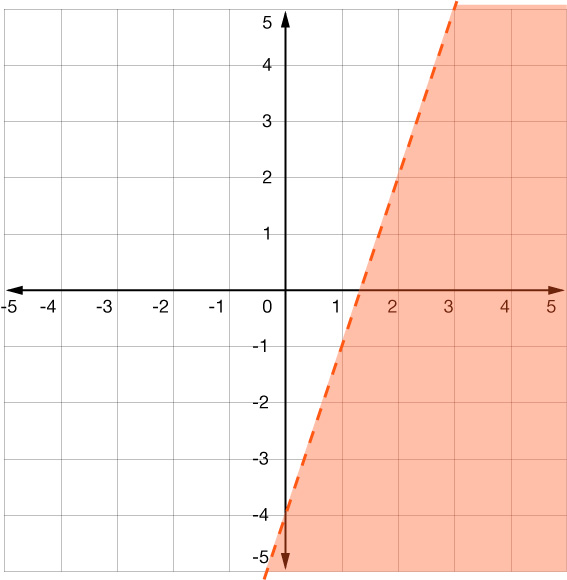
- Which inequality represents the graph?
-
-
-
-
For questions 10 and 11, use this graph of the equation as a guide to answer the questions.
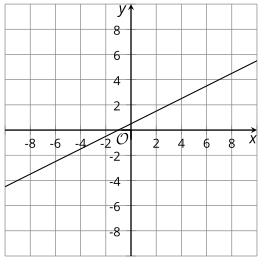
- Is the point a solution to the equation?
-
Yes
-
No
- Is the point a solution to the inequality ?
-
Yes
-
No
- Consider the linear equation . The pair is a solution to the equation. Which of the following is also a solution to the equation?
-
-
-
-
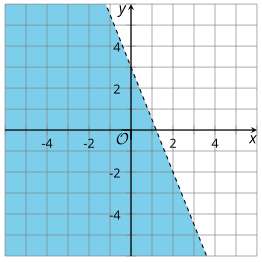
- The boundary line on the graph represents the equation . Write an inequality that is represented by the graph.
-
-
-
-