Chapter 2

Chapter 2

Problem 2-3
H3C−OH < H3C−MgBr < H3C−Li = H3C−F < H3C−K
Problem 2-4
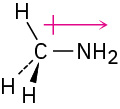
The nitrogen is electron-rich, and the carbon is electron-poor.

The chemical structure of methylamine where the direction of the dipole moment points from carbon toward nitrogen.
Problem 2-5

The two C–O dipoles cancel because of the symmetry of the molecule:

The chemical structure of ethylene glycol, where the direction of both dipole moments points from carbon toward the hydroxyl group in opposite directions.
Problem 2-7
(a)
For carbon: FC = 4 − 8/2 − 0 = 0 For the middle nitrogen: FC = 5 − 8/2 − 0 = +1 For the end nitrogen: FC = 5 − 4/2 − 4 = −1
(b)
For nitrogen: FC = 5 − 8/2 − 0 = +1 For oxygen: FC = 6 − 2/2 − 6 = −1
(c)
For nitrogen: FC = 5 − 8/2 − 0 = +1 For the triply bonded carbon: FC = 4 − 6/2 − 2 = −1
Problem 2-9
The structures in (a) are resonance forms.
Problem 2-12
Phenylalanine is stronger.
Problem 2-13
Water is a stronger acid.
Problem 2-14
Neither reaction will take place.
Problem 2-15
Reaction will take place.
Problem 2-16
Ka = 4.9 × 10⁻¹⁰
Problem 2-19
Vitamin C is water-soluble (hydrophilic); vitamin A is fat-soluble (hydrophobic).