Chapter 15

Chapter 15

Problem 15-1
(a)
Meta
(b)
Para
(c)
Ortho
Problem 15-2
(a)
m-Bromochlorobenzene
(b)
(3-Methylbutyl)benzene
(c)
p-Bromoaniline
(d)
2,5-Dichlorotoluene
(e)
1-Ethyl-2,4-dinitrobenzene
(f)
1,2,3,5-Tetramethylbenzene
Problem 15-4

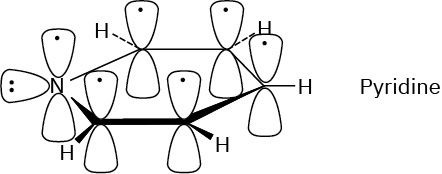
Pyridine has an aromatic sextet of electrons.

Pyridine has three lobes around nitrogen. One lobe has an unpaired electron and one lobe has a lone pair of electrons. Upper lobe of each carbon has an unpaired electron.
Problem 15-5
Cyclodecapentaene is not flat because of steric interactions.
Problem 15-6
All C – C bonds are equivalent; one resonance line in both 1H and 13C NMR spectra.
Problem 15-7
The cyclooctatetraenyl dianion is aromatic (ten π electrons) and flat.
Problem 15-10
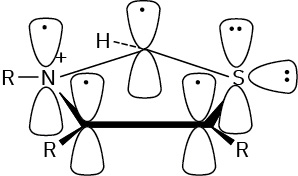
The thiazolium ring has six π electrons.

The orbital representation of thiazolium ring shows two lobes around sulfur each with a lone pair and upper lobes of the remaining atoms of the ring each with an unpaired electron.
Problem 15-11

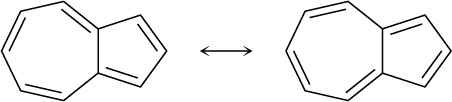
Yes, it's aromatic.

Two resonance structures of azulene, separated by a double-headed arrow.
Problem 15-12
The three nitrogens in double bonds each contribute one; the remaining nitrogen contributes two.