Additional Problems
10 • Additional Problems
10 • Additional Problems
Visualizing Chemistry
Problem
10-14
Give IUPAC names for the following alkyl halides (green = Cl):
Problem
10-15
Show the product(s) of reaction of the following alkenes with NBS:
Problem
10-16
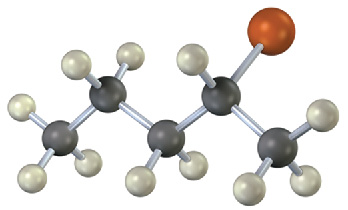
The following alkyl bromide can be prepared by reaction of the alcohol (S)-2-pentanol with PBr3. Name the compound, assign (R) or (S) stereochemistry, and tell whether the reaction of the alcohol results in the same stereochemistry or a change in stereochemistry (reddish brown = Br).
Mechanism Problems
Problem
10-17
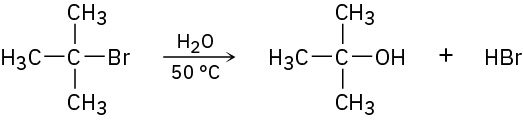
In light of the fact that tertiary alkyl halides undergo spontaneous dissociation to yield a carbocation plus halide ion (see Problem 10-41), propose a mechanism for the following reaction.
Naming Alkyl Halides
Problem
10-18
Name the following alkyl halides:
Problem
10-19
Draw structures corresponding to the following IUPAC names:
(a)
2,3-Dichloro-4-methylhexane
(b)
4-Bromo-4-ethyl-2-methylhexane
(c)
3-Iodo-2,2,4,4-tetramethylpentane
(d)
cis-1-Bromo-2-ethylcyclopentane
Problem
10-20
Draw and name all the monochlorination products you might obtain from radical chlorination of the following compounds. Which of the products are chiral? Are any of the products optically active?
Synthesizing Alkyl Halides
Problem
10-21
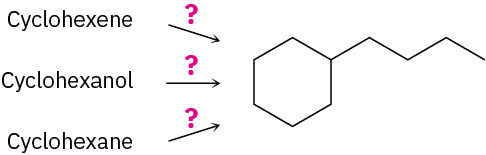
How would you prepare the following compounds, starting with cyclopentene and any other reagents needed?
(e)
Cyclopentylcyclopentane
Problem
10-22
Predict the product(s) of the following reactions:
Problem
10-23
A chemist requires a large amount of 1-bromo-2-pentene as starting material for a synthesis and decides to carry out an NBS allylic bromination reaction. What is wrong with the following synthesis plan? What side products would form in addition to the desired product?

Problem
10-24
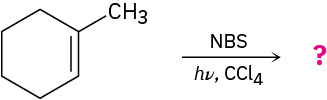
What product(s) would you expect from the reaction of 1-methylcyclohexene with NBS? Would you use this reaction as part of a synthesis?
Problem
10-25
What product(s) would you expect from the reaction of 1,4-hexadiene with NBS? What is the structure of the most stable radical intermediate?
Problem
10-26
What product would you expect from the reaction of 1-phenyl-2-butene with NBS? Explain.

Oxidation and Reduction
Problem
10-27
Rank the compounds in each of the following series in order of increasing oxidation level:
Problem
10-28
Which of the following compounds have the same oxidation level, and which have different levels?

Problem
10-29
Tell whether each of the following reactions is an oxidation, a reduction, or neither:
General Problems
Problem
10-30
Arrange the following radicals from most stable to least stable.
Problem
10-31
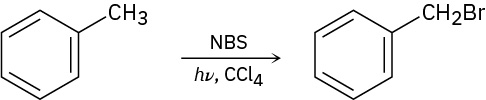
Alkylbenzenes such as toluene (methylbenzene) react with NBS to give products in which bromine substitution has occurred at the position next to the aromatic ring (the benzylic position). Explain, based on the bond dissociation energies in Table 6.3.
Problem
10-32
Draw resonance structures for the benzyl radical, C6H5CH2·, the intermediate produced in the NBS bromination reaction of toluene (Problem 10-31).
Problem
10-33
Draw resonance structures for the following species:
Problem
10-34
(S)-3-Methylhexane undergoes radical bromination to yield optically inactive 3-bromo-3-methylhexane as the major product. Is the product chiral? What conclusions can you draw about the radical intermediate?
Problem
10-35
Assume that you have carried out a radical chlorination reaction on (R)-2-chloropentane and have isolated (in low yield) 2,4-dichloropentane. How many stereoisomers of the product are formed, and in what ratio? Are any of the isomers optically active? (See Problem 10-34.)
Problem
10-36
How would you carry out the following syntheses?
Problem
10-37
The syntheses shown here are unlikely to occur as written. What is wrong with each?
Problem
10-38
Why do you suppose it’s not possible to prepare a Grignard reagent from a bromo alcohol such as 4-bromo-1-pentanol? Give another example of a molecule that is unlikely to form a Grignard reagent.

Problem
10-39
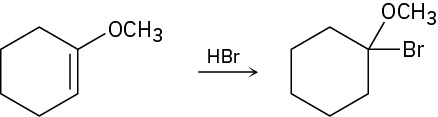
Addition of HBr to a double bond with an ether (−OR) substituent occurs regiospecifically to give a product in which the −Br and −OR are bonded to the same carbon. Draw the two possible carbocation intermediates in this electrophilic addition reaction, and explain using resonance why the observed product is formed.
Problem
10-40
Identify the reagents a–c in the following scheme:

Problem
10-41
Tertiary alkyl halides, R3CX, undergo spontaneous dissociation to yield a carbocation, R3C+, plus halide ion. Which do you think reacts faster, (CH3)3CBr or H2CCHC(CH3)2Br? Explain.
Problem
10-42
Carboxylic acids (RCO2H; pKa ≈ 5) are approximately 1011 times more acidic than alcohols (ROH; pKa ≈ 16). In other words, a carboxylate ion (RCO2−) is more stable than an alkoxide ion (RO−). Explain, using resonance.
Problem
10-43
How might you use a Suzuki–Miyaura reaction to prepare the biaryl compounds below? In each case, show the two potential reaction partners.
Problem
10-44
The relative rate of radical bromination is 1 : 82 : 1640 for 1° : 2° : 3° hydrogens, respectively. Draw all of the monobrominated products that you might obtain from the radical bromination of the compounds below. Calculate the relative percentage of each.
Problem
10-45
Choose the alcohol from each pair below that would react faster with HX to form the corresponding alkyl halide.
Problem
10-46
Predict the product and provide the entire catalytic cycle for the following Suzuki–Miyaura reactions.