Chapter 10

Chapter 10

Problem 10-1
(a)
1-Iodobutane
(b)
1-Chloro-3-methylbutane
(c)
1,5-Dibromo-2,2-dimethylpentane
(d)
1,3-Dichloro-3-methylbutane
(e)
1-Chloro-3-ethyl-4-iodopentane
(f)
2-Bromo-5-chlorohexane
Problem 10-3
Chiral: 1-chloro-2-methylpentane, 3-chloro-2-methylpentane, 2-chloro-4-methylpentane Achiral: 2-chloro-2-methylpentane, 1-chloro-4-methylpentane
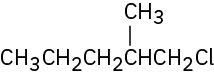
A condensed formula for 1-chloro-2-methylpentane.
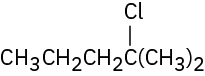
A condensed formula for 2-chloro-2-methylpentane.
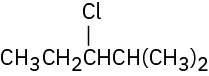
A condensed formula for 3-chloro-2-methylpentane.
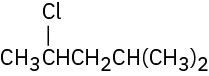
A condensed formula for 2-chloro-4-methylpentane.
A condensed formula for 1-chloro-4-methylpentane.
Problem 10-4
1-Chloro-2-methylbutane (29%), 1-chloro-3-methylbutane (14%), 2-chloro-2-methylbutane (24%), 2-chloro-3-methylbutane (33%)
Problem 10-6
The intermediate allylic radical reacts at the more accessible site and gives the more highly substituted double bond.
Problem 10-7
(a)
3-Bromo-5-methylcycloheptene and 3-bromo-6-methylcycloheptene
(b)
Four products
Problem 10-8
(a)
2-Methyl-2-propanol + HCl
(b)
4-Methyl-2-pentanol + PBr3
(c)
5-Methyl-1-pentanol + PBr3
(d)
3,3-Dimethyl-cyclopentanol + HF, pyridine
Problem 10-9
Both reactions occur.
Problem 10-10
React Grignard reagent with D2O.
Problem 10-11
(a)
1. NBS; 2. (CH3)2CuLi
(b)
1. Li; 2. CuI; 3. CH3CH2CH2CH2Br
(c)
1. BH3; 2. H2O2, NaOH; 3. PBr3; 4. Li, then CuI; 5. CH3(CH2)4Br
Problem 10-13
(a)
Reduction
(b)
Neither