Additional Problems
20 • Additional Problems
20 • Additional Problems
Visualizing Chemistry
Problem
20-17
Give IUPAC names for the following carboxylic acids (reddish brown = Br):
Problem
20-18
Would you expect the following carboxylic acids to be more acidic or less acidic than benzoic acid? Explain. (Reddish brown = Br.)
Problem
20-19
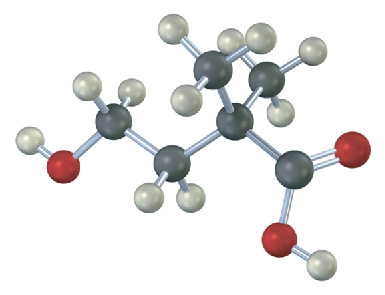
The following carboxylic acid can’t be prepared from an alkyl halide by either the nitrile hydrolysis route or the Grignard carboxylation route. Explain.
Problem
20-20
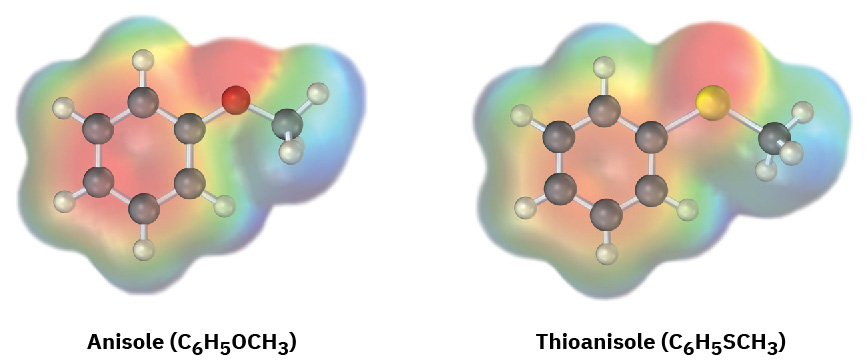
Electrostatic potential maps of anisole and thioanisole are shown. Which do you think is the stronger acid, p-methoxybenzoic acid or p-(methylthio)benzoic acid? Explain.
Mechanism Problems
Problem
20-21
Predict the product(s) and write the mechanism of each of the following reactions:
Problem
20-22
Predict the product(s) and write the mechanism of each of the following reactions:
Problem
20-23
Predict the product(s) and write the mechanism of each of the following reactions:
Problem
20-24
Predict the product(s) and write the complete mechanism of each of the following reactions:
Problem
20-25
Acid-catalyzed hydrolysis of a nitrile to give a carboxylic acid occurs by initial protonation of the nitrogen atom, followed by nucleophilic addition of water. Review the mechanism of base-catalyzed nitrile hydrolysis in Section 20.7 and then predict the products for the following reactions. Write the steps involved in the acid-catalyzed reaction, using curved arrows.
Problem
20-26
Nitriles can be converted directly to esters by the Pinner reaction, which first produces an iminoester salt that is isolated and then treated with water to give the final product. Propose a mechanism for the Pinner reaction using curved arrows to show the flow of electrons at each step.

Problem
20-27
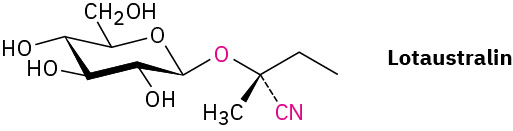
Naturally occurring compounds called cyanogenic glycosides, such as lotaustralin, release hydrogen cyanide, HCN, when treated with aqueous acid. The reaction occurs by hydrolysis of the acetal linkage to form a cyanohydrin, which then expels HCN and gives a carbonyl compound.
(a)
Show the mechanism of the acetal hydrolysis and the structure of the cyanohydrin that results.
(b)
Propose a mechanism for the loss of HCN, and show the structure of the carbonyl compound that forms.
Problem
20-28
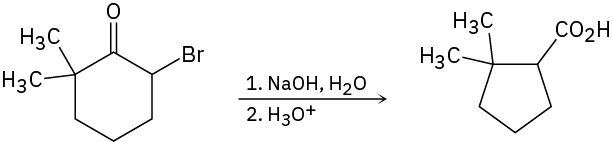
2-Bromo-6,6-dimethylcyclohexanone gives 2,2-dimethylcyclopentanecarboxylic acid on treatment with aqueous NaOH followed by acidification, a process called the Favorskii reaction. Propose a mechanism.
Problem
20-29
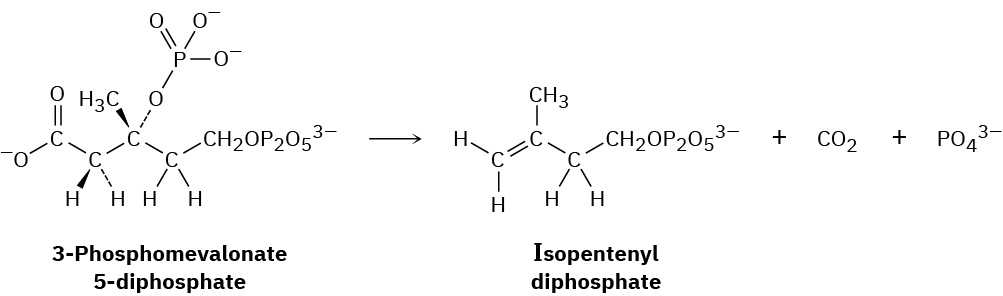
Naturally occurring compounds called terpenoids, which we’ll discuss in Section 27.5, are biosynthesized by a pathway that involves loss of CO2 from 3-phosphomevalonate 5-diphosphate to yield isopentenyl diphosphate. Use curved arrows to show the mechanism of this reaction.
Problem
20-30
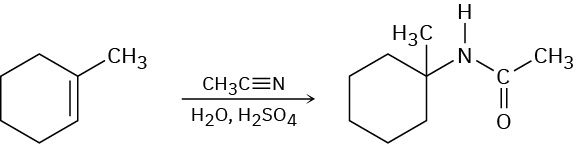
In the Ritter reaction, an alkene reacts with a nitrile in the presence of strong aqueous sulfuric acid to yield an amide. Propose a mechanism.
Naming Carboxylic Acids and Nitriles
Problem
20-31
Give IUPAC names for the following compounds:
Problem
20-32
Draw structures corresponding to the following IUPAC names:
(a)
cis-1,2-Cyclohexanedicarboxylic acid
(d)
4-Ethyl-2-propyloctanoic acid
(e)
3-Chlorophthalic acid
(g)
2-Cyclobutenecarbonitrile
(h)
m-Benzoylbenzonitrile
Problem
20-33
Draw and name the following compounds:
(a)
The eight carboxylic acids with the formula C6H12O2
(b)
Three nitriles with the formula C5H7N
Problem
20-34
Pregabalin, marketed as Lyrica, is an anticonvulsant drug that is also effective in treating chronic pain. The IUPAC name of pregabalin is (S)-3-(aminomethyl)-5-methylhexanoic acid. (An aminomethyl group is –CH2NH2.) Draw the structure of pregabalin.
Problem
20-35
Isocitric acid, an intermediate in the citric acid cycle of food metabolism, has the systematic name (2R,3S)-3-carboxy-2-hydroxypentanedioic acid. Draw the structure.
Acidity of Carboxylic Acids
Problem
20-36
Order the compounds in each of the following sets with respect to increasing acidity:
(a)
Acetic acid, oxalic acid, formic acid
(b)
p-Bromobenzoic acid, p-nitrobenzoic acid, 2,4-dinitrobenzoic acid
(c)
Fluoroacetic acid, 3-fluoropropanoic acid, iodoacetic acid
Problem
20-37
Arrange the compounds in each of the following sets in order of increasing basicity:
(a)
Magnesium acetate, magnesium hydroxide, methylmagnesium bromide
(b)
Sodium benzoate, sodium p-nitrobenzoate, sodium acetylide
(c)
Lithium hydroxide, lithium ethoxide, lithium formate
Problem
20-38
Calculate the pKa’s of the following acids:
(a)
Lactic acid, Ka = 8.4 × 10⁻⁴
(b)
Acrylic acid, Ka = 5.6 × 10⁻⁶
Problem
20-39
Calculate the Ka’s of the following acids:
(a)
Citric acid, pKa = 3.14
(b)
Tartaric acid, pKa = 2.98
Problem
20-40
Thioglycolic acid, HSCH2CO2H, a substance used in depilatory agents (hair removers) has pKa = 3.42. What is the percent dissociation of thioglycolic acid in a buffer solution at pH = 3.0?
Problem
20-41
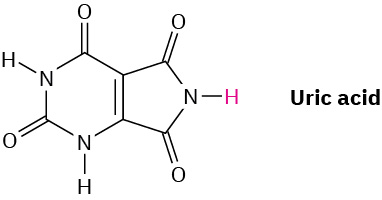
In humans, the final product of purine degradation from DNA is uric acid, pKa = 5.61, which is excreted in the urine. What is the percent dissociation of uric acid in urine at a typical pH = 6.0? Why do you think uric acid is acidic even though it does not have a CO2H group?
Problem
20-42
Some pKa data for simple dibasic acids is shown. How can you account for the fact that the difference between the first and second ionization constants decreases with increasing distance between the carboxyl groups?
| Name |
Structure |
pK1 |
pK2 |
| Oxalic |
HO2CCO2H |
1.2 |
4.2 |
| Succinic |
HO2CCH2CH2CO2H |
4.2 |
5.6 |
| Adipic |
HO2C(CH2)4CO2H |
4.4 |
5.4 |
Reactions of Carboxylic Acids and Nitriles
Problem
20-43
How could you convert butanoic acid into the following compounds? Write each step showing the reagents needed.
Problem
20-44
How could you convert each of the following compounds into butanoic acid? Write each step showing all reagents.
Problem
20-45
How could you convert butanenitrile into the following compounds? Write each step showing the reagents needed.
Problem
20-46
How would you prepare the following compounds from benzene? More than one step is needed in each case.
(c)
Phenylacetic acid, C6H5CH2CO2H
Problem
20-47
Predict the product of the reaction of p-methylbenzoic acid with each of the following:
(b)
N-Bromosuccinimide in CCl4
(c)
CH3MgBr in ether, then H3O+
Problem
20-48
Using 13CO2 as your only source of labeled carbon, along with any other compounds needed, how would you synthesize the following compounds?
Problem
20-49
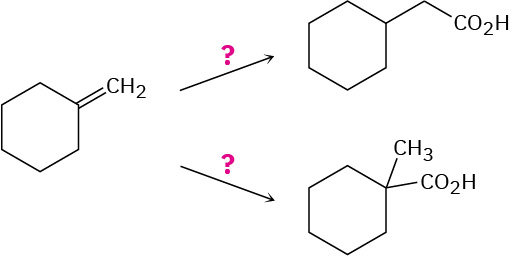
How would you carry out the following transformations?
Problem
20-50
Which method—Grignard carboxylation or nitrile hydrolysis—would you use for each of the following reactions? Explain.
Problem
20-51
1,6-Hexanediamine, a starting material needed for making nylon, can be made from 1,3-butadiene. How would you accomplish the synthesis?

Problem
20-52
3-Methyl-2-hexenoic acid (mixture of E and Z isomers) has been identified as the substance responsible for the odor of human sweat. Synthesize the compound from starting materials having five or fewer carbons.
Spectroscopy
Problem
20-53
Propose a structure for a compound C6H12O2 that dissolves in dilute NaOH and shows the following 1H NMR spectrum: 1.08 δ (9 H, singlet), 2.2 δ (2 H, singlet), and 11.2 δ (1 H, singlet).
Problem
20-54
What spectroscopic method could you use to distinguish among the following three isomeric acids? Tell what characteristic features you would expect for each acid.

Problem
20-55
How would you use NMR (either 13C or 1H) to distinguish between the following pairs of isomers?
Problem
20-56
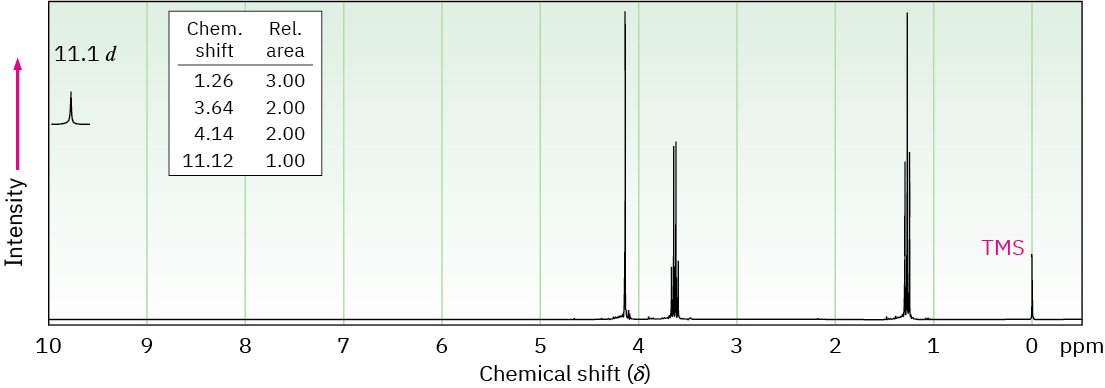
Compound A, C4H8O3, has infrared absorptions at 1710 and 2500 to 3100 cm–1 and has the 1H NMR spectrum shown. Propose a structure for A.
General Problems
Problem
20-57
A chemist in need of 2,2-dimethylpentanoic acid decided to synthesize some by reaction of 2-chloro-2-methylpentane with NaCN, followed by hydrolysis of the product. After the reaction sequence was carried out, however, none of the desired product could be found. What do you suppose went wrong?
Problem
20-58
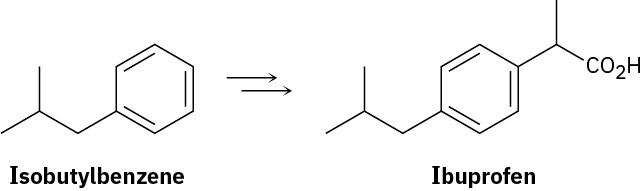
Show how you might prepare the anti-inflammatory agent ibuprofen starting from isobutylbenzene. More than one step is needed.
Problem
20-59
The following synthetic schemes all have at least one flaw in them. What is wrong with each?
Problem
20-60
p-Aminobenzoic acid (PABA) was once widely used as a sunscreen agent. Propose a synthesis of PABA starting from toluene.
Problem
20-61
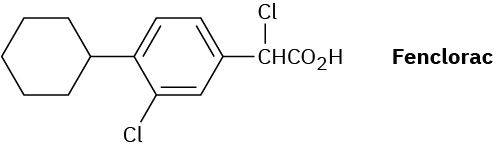
Propose a synthesis of the anti-inflammatory drug fenclorac from phenylcyclohexane.
Problem
20-62
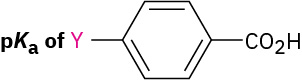
The pKa’s of five p-substituted benzoic acids (YC6H4CO2H) are listed below. Rank the corresponding substituted benzenes (YC6H5) in order of their increasing reactivity toward electrophilic aromatic substitution. If benzoic acid has pKa = 4.19, which of the substituents are activators and which are deactivators?
| Substituent Y |
 |
| –Si(CH3)3 |
4.27 |
| –CH═CHC≡N |
4.03 |
| –HgCH3 |
4.10 |
| –OSO2CH3 |
3.84 |
| –PCl2 |
3.59 |
Problem
20-63
How would you carry out the following transformations? More than one step is needed in each case.
Problem
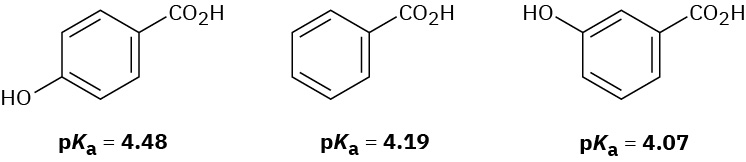
20-64
The following pKa values have been measured. Explain why a hydroxyl group in the para position decreases the acidity while a hydroxyl group in the meta position increases the acidity.
Problem
20-65
Identify the missing reagents a–f in the following scheme:

Problem
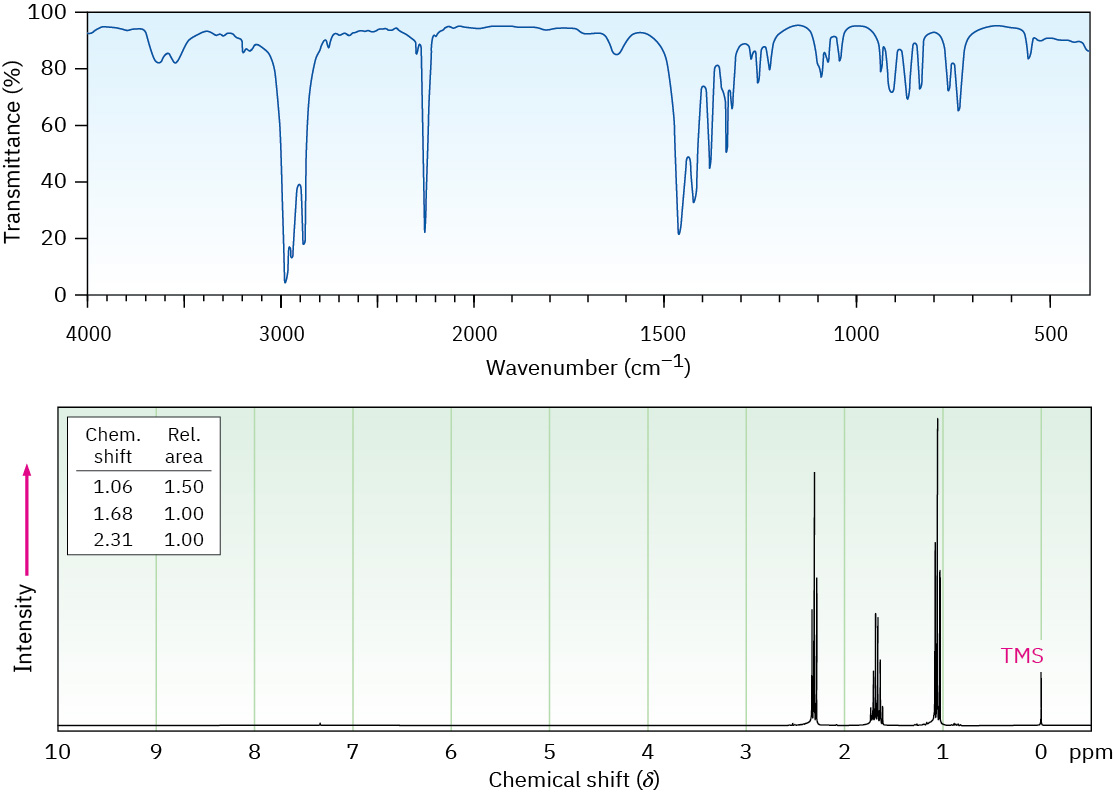
20-66
Propose a structure for a compound, C4H7N, that has the following IR and 1H NMR spectra:
Problem
20-67
The two 1H NMR spectra shown here belong to crotonic acid (trans-CH3CHCHCO2H) and methacrylic acid [H2CC(CH3)CO2H]. Which spectrum corresponds to which acid? Explain.
Problem
20-68
The 1H and 13C NMR spectra below belong to a compound with formula C6H10O2. Propose a structure for this compound.
Problem
20-69
Propose structures for carboxylic acids that show the following peaks in their 13C NMR spectra. Assume that the kinds of carbons (1°, 2°, 3°, or 4°) have been assigned by DEPT-NMR.
(a)
C7H12O2: 25.5 δ (2°), 25.9 δ (2°), 29.0 δ (2°), 43.1 δ (3°), 183.0 δ (4°)
(b)
C8H8O2: 21.4 δ (1°), 128.3 δ (4°), 129.0 δ (3°), 129.7 δ (3°), 143.1 δ (4°), 168.2 δ (4°)
Problem
20-70
Carboxylic acids having a second carbonyl group two atoms away lose CO2 (decarboxylate) through an intermediate enolate ion when treated with base. Write the mechanism of this decarboxylation reaction using curved arrows to show the electron flow in each step.
