Chapter 1

Chapter 1

Problem 1-1
(a)
1s2 2s2 2p4
(b)
1s2 2s2 2p3
(c)
1s2 2s2 2p6 3s2 3p4
Problem 1-5
(a)
CCl4
(b)
AlH3
(c)
CH2Cl2
(d)
SiF4
(e)
CH3NH2
Problem 1-7
C2H7 has too many hydrogens for a compound with two carbons.
Problem 1-10
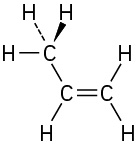
The CH3 carbon is sp3; the double-bond carbons are sp2; the C = C−C and C = C−H bond angles are approximately 120°; other bond angles are near 109°.

The chemical structure of propene featuring the wedge-dash bonds between hydrogen and C3.
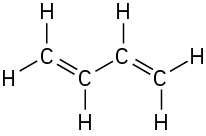
Problem 1-11

All carbons are sp2, and all bond angles are near 120°.

The chemical structure of 1,3-butadiene.
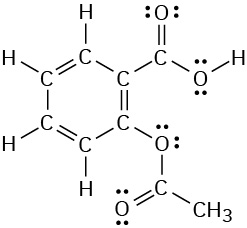
Problem 1-12

All carbons except CH3 are sp2.

The chemical structure of aspirin featuring two lone pairs on each oxygen atom.
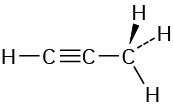
Problem 1-13

The CH3 carbon is sp3; the triple-bond carbons are sp; the C ≡ C−C and H−C ≡ C bond angles are approximately 180°.

The wedge-dash structure of propyne.
Problem 1-14
(a)
O has 2 lone pairs and is sp3-hybridized.
(b)
N has 1 lone pair and is sp3-hybridized.
(c)
P has 1 lone pair and is sp3-hybridized.
(d)
S has 2 lone pairs and is sp3-hybridized.
Problem 1-16
(a)

There are numerous possibilities, such as:

Chemical structures of n-pentane, isopentane, and neopentane.
(b)

There are numerous possibilities, such as:

Chemical structures of ethylamine and dimethylamine.
(c)

There are numerous possibilities, such as:

Chemical structures of propanal, 2-propen-1-ol, 1-propen-1-ol, methyl vinyl ether, cyclopropanol, propylene oxide, oxetane, acetone, and 1-propen-2-ol.
(d)

There are numerous possibilities, such as:

Chemical structures of 1-chlorobutane, 2-chlorobutane, 1-chloro-2-methylpropane, and t-butylchloride.