Chapter 13

Chapter 13

Problem 13-1
7.5 × 10⁻⁵ kJ/mol for 19F; 8.0 × 10⁻⁵ kJ/mol for 1H
Problem 13-2
1.2 × 10⁻⁴ kJ/mol
Problem 13-3
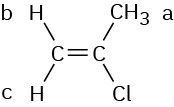
The vinylic C − H protons are nonequivalent.

A chemical structure of 2-chloro-1-propene. Hydrogens are labeled a (on methyl), b (cis to methyl group) and c (cis to chlorine).
Problem 13-4
(a)
7.27 δ
(b)
3.05 δ
(c)
3.46 δ
(d)
5.30 δ
Problem 13-5
(a)
420 Hz
(b)
2.1 δ
(c)
1050 Hz
Problem 13-6
(a)
1.43 δ
(b)
2.17 δ
(c)
7.37 δ
(d)
5.30 δ
(e)
9.70 δ
(f)
2.12 δ
Problem 13-7

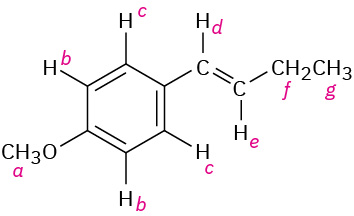
There are seven kinds of protons labeled. The types and expected range of absorption of each follow. a: ether, 3.5–4.5 δ; b: aryl, 6.5–8.0 δ; c: aryl, 6.5–8.0; d: vinylic, 4.5–6.5 δ; e: vinylic, 4.5–6.5 δ; f: alkyl (secondary), 1.2–1.6 δ; g: alkyl (primary), 0.7–1.3 δ.

Structure of 1-[(E)-but-1-enyl]-4-methoxybenzene. Hydrogens labeled a (methoxy), b  and c (ortho and meta to methoxy), d (benzylic), e (trans to d), f (methylene), and g (methyl) .
Problem 13-8
Two peaks; 3 : 2 ratio
Problem 13-9
(a)
 −CHBr2, quartet;  −CH3, doublet
(b)
CH3O−, singlet;  −OCH2 −, triplet;  −CH2Br, triplet
(c)
ClCH2− , triplet;  −CH2−, quintet
(d)
CH3− , triplet;  −CH2− , quartet;   −CH− , septet; (CH3)2, doublet
(e)
CH3−, triplet;  −CH2−, quartet;   −CH−, septet; (CH3)2, doublet
(f)
= CH, triplet,  −CH2−, doublet, aromatic C−H, two multiplets
Problem 13-10
(a)
CH3OCH3
(b)
CH3CH(Cl)CH3
(c)
ClCH2CH2OCH2CH2Cl
(d)
CH3CH2CO2CH3 or CH3CO2CH2CH3
Problem 13-11
CH3CH2OCH2CH3
Problem 13-12
(a)
Enantiotopic
(b)
Diastereotopic
(c)
Diastereotopic
(d)
Diastereotopic
(e)
Diastereotopic
(f)
Homotopic
Problem 13-15

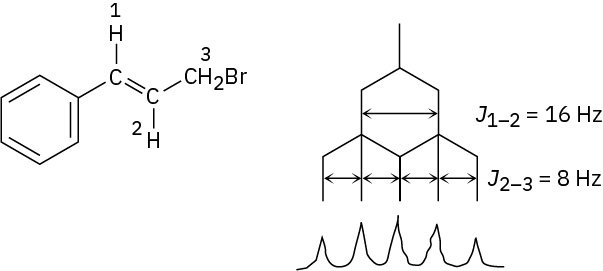
J1–2 = 16 Hz; J2–3 = 8 Hz

The structure of 3-Bromo-1-phenyl-1-propene and its proton splitting tree diagram that shows J 1-2 and J 2-3 values equals 16 and 8 Hertz, respectively.
Problem 13-16
1-Chloro-1-methylcyclohexane has a singlet methyl absorption.
Problem 13-18
(a)
1,3-Dimethylcyclopentene
(b)
2-Methylpentane
(c)
1-Chloro-2-methylpropane
Problem 13-19
−CH3, 9.3 δ;  −CH2− , 27.6 δ; C=O, 174.6 δ;− OCH3, 51.4 δ
Problem 13-23
A DEPT-90 spectrum would show two absorptions for the non-Markovnikov product (RCH = CHBr) but no absorptions for the Markovnikov product (RBrC = CH2).