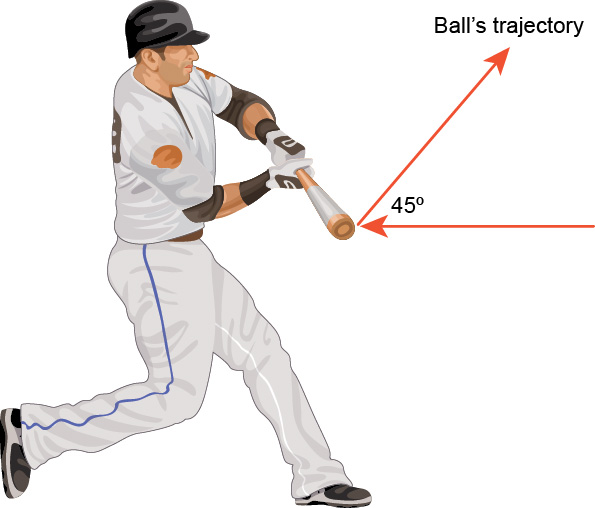
A 145-g baseball is incoming at a velocity of 35 m/s. The batter hits the ball as shown in the image. The outgoing baseball has a velocity of 40 m/s at the angle shown.
What is the magnitude of the x-component of the impulse?
0.26 kg⋅m/s.
4.09 kg⋅m/s.
4.35 kg⋅m/s.
8.44 kg⋅m/s.
17.
For how long should a force of 130 N be applied to an object of mass 50 kg to change its speed from 20 m/s to 60 m/s?
In an elastic collision, an object with momentum 25 kg⋅m/s (moving to the left) collides with another that has a momentum 35 kg⋅m/s, moving toward it to the right. The first object’s momentum changes to 15 kg⋅m/s, and it is now moving to the right. What is the magnitude of the momentum of the second object after the collision?
5 kg⋅m/s
10 kg⋅m/s
25 kg⋅m/s
75 kg⋅m/s
19.
Find the recoil velocity of a ice hockey goalie who catches a hockey puck slapped at him at a velocity of . Assume that the goalie is at rest before catching the puck, and friction between the ice and the puck-goalie system is negligible.