Concept Items

Concept Items

2.1 Relative Motion, Distance, and Displacement

1 .
Can one-dimensional motion be described with a zero distance traveled but nonzero displacement. Conversely, can it be described with zero displacement but a nonzero distance traveled?
  1. One-dimensional motion can have zero distance traveled with a nonzero displacement. Displacement has both magnitude and direction; it can also have zero displacement with nonzero distance traveled because distance traveled has only magnitude.
  2. One-dimensional motion can have zero distance traveled with a nonzero displacement. Displacement has both magnitude and direction, but it cannot have zero displacement with nonzero distance traveled because distance has only magnitude.
  3. One-dimensional motion cannot have zero distance traveled with a nonzero displacement. Displacement has both magnitude and direction, but it can have zero displacement with nonzero distance traveled because distance has only magnitude and any motion will be the distance it moves.
  4. One-dimensional motion cannot have zero distance traveled with a nonzero displacement. Displacement has both magnitude and direction; it cannot have zero displacement with nonzero distance traveled because distance has only magnitude.
2.

In which example would you be correct in describing an object in motion while your friend would also be correct in describing that same object as being at rest?

  1. You are driving a car toward the east and your friend drives past you in the opposite direction with the same speed. In your frame of reference, you will be in motion. In your friend’s frame of reference, you will be at rest.
  2. You are driving a car toward the east and your friend is standing at the bus stop. In your frame of reference, you will be in motion. In your friend’s frame of reference, you will be at rest.
  3. You are driving a car toward the east and your friend is standing at the bus stop. In your frame of reference, your friend will be moving toward the west. In your friend’s frame of reference, he will be at rest.
  4. You are driving a car toward the east and your friend is standing at the bus stop. In your frame of reference, your friend will be moving toward the east. In your friend’s frame of reference, he will be at rest.
3 .
What does your car’s odometer record?
  1. displacement
  2. distance
  3. both distance and displacement
  4. the sum of distance and displacement

2.2 Speed and Velocity

4 .
In the definition of velocity, what physical quantity is changing over time?
  1. speed
  2. distance
  3. magnitude of displacement
  4. position vector
5 .
Which of the following best describes the relationship between instantaneous velocity and instantaneous speed?
  1. Both instantaneous speed and instantaneous velocity are the same, even when there is a change in direction.
  2. Instantaneous speed and instantaneous velocity cannot be the same, even if there is no change in the direction of motion.
  3. The magnitude of instantaneous velocity is equal to instantaneous speed.
  4. The magnitude of instantaneous velocity is always greater than instantaneous speed.

2.3 Position vs. Time Graphs

6.

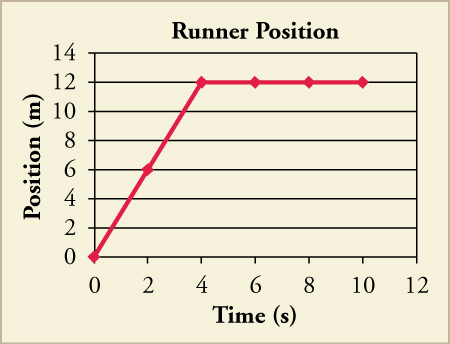
Use the graph to describe what the runner’s motion looks like.

A graph titled Runner Position plots time (s) on the x axis, and position (m) on the y axis. A line extends from the origin with a slope of 3. At point (12, 4), it extends without a slope and points (12, 6), (12, 8), and (12, 10) are marked.

How are average velocity for only the first four seconds and instantaneous velocity related? What is the runner's net displacement over the time shown?

  1. The net displacement is 12 m and the average velocity is equal to the instantaneous velocity.
  2. The net displacement is 12 m and the average velocity is two times the instantaneous velocity.
  3. The net displacement is 10 + 12 = 22 m and the average velocity is equal to the instantaneous velocity.
  4. The net displacement is 10 + 12 = 22 m and the average velocity is two times the instantaneous velocity.
7 .
A position vs. time graph of a frog swimming across a pond has two distinct straight-line sections. The slope of the first section is 1 m/s . The slope of the second section is 0 m/s . If each section lasts 1 second , then what is the frog’s total average velocity?
  1. 0 m/s
  2. 2 m/s
  3. 0.5 m/s
  4. 1 m/s

2.4 Velocity vs. Time Graphs

8.

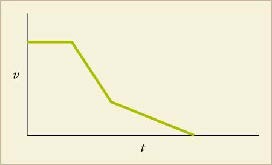
A graph of velocity vs. time of a ship coming into a harbor is shown.

no alt text

Describe the acceleration of the ship based on the graph.

  1. The ship is moving in the forward direction at a steady rate. Then it accelerates in the forward direction and then decelerates.
  2. The ship is moving in the forward direction at a steady rate. Then it turns around and starts decelerating, while traveling in the reverse direction. It then accelerates, but slowly.
  3. The ship is moving in the forward direction at a steady rate. Then it decelerates in the forward direction, and then continues to slow down in the forward direction, but with more deceleration.
  4. The ship is moving in the forward direction at a steady rate. Then it decelerates in the forward direction, and then continues to slow down in the forward direction, but with less deceleration.