Short Answer

Short Answer

22.1 The Structure of the Atom

21.

Why do Bohr’s calculations for electron energies not work for all atoms?

  1. In atoms with more than one electron is an atomic shell, the electrons will interact. That requires a more complex formula than Bohr’s calculations accounted for.
  2. In atoms with 10 or more electorns in an atomic shell, the electrons will interact. That requires a more complex formula than Bohr’s calculations accounted for.
  3. In atoms with more than one electron in an atomic shell, the electrons will not interact. That requires a more complex formula than Bohr’s calculations accounted for.
  4. In atoms with 10 or more electrons in an atomic shell, the electrons will not interact. That requires a more complex formula than Bohr’s calculations accounted for.

22.2 Nuclear Forces and Radioactivity

22 .
Does transmutation occur within chemical reactions?
  1. no
  2. yes

22.3 Half Life and Radiometric Dating

23 .
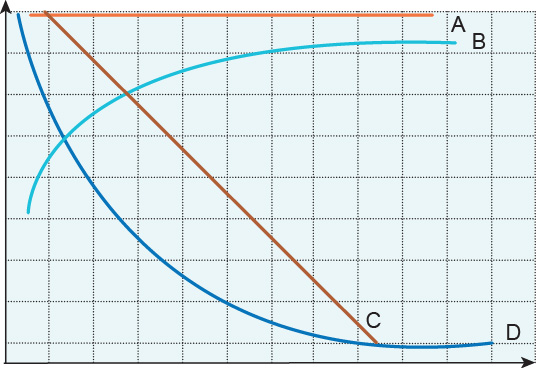
Which curve on the following graph of N (radionuclides) versus time represents radioactive decay?
  1. A
  2. B
  3. C
  4. D

22.4 Nuclear Fission and Fusion

24 .
Why does fission of heavy nuclei result in the release of neutrons?
  1. Heavy nuclei require more neutrons to achieve stability.
  2. Heavy nuclei require more neutrons to balance charge.
  3. Light nuclei require more neutrons to achieve stability.
  4. Light nuclei require more neutrons to balance charge.

22.5 Medical Applications of Radioactivity: Diagnostic Imaging and Radiation

25 .
Why is radioactive iodine used to monitor the thyroid?
  1. Radioactive iodine can be used by the thyroid while absorbing information about the thyroid.
  2. Radioactive iodine can be used by the thyroid while emitting information about the thyroid.
  3. Radioactive iodine can be secreted by the thyroid while absorbing information about the thyroid.
  4. Radioactive iodine can be secreted by the thyroid while emitting information about the thyroid.