Concept Items

Concept Items

19.1 Ohm's law

1 .
You connect a resistor across a battery. In which direction do the electrons flow?
  1. The electrons flow from the negative terminal of the battery to the positive terminal of the battery.
  2. The electrons flow from the positive terminal of the battery to the negative terminal of the battery.
2 .
How does current depend on resistance in Ohm’s law?
  1. Current is directly proportional to the resistance.
  2. Current is inversely proportional to the resistance.
  3. Current is proportional to the square of the resistance.
  4. Current is inversely proportional to the square of the resistance.
3 .
In the context of electricity, what is resistivity?
  1. Resistivity is the property of materials to resist the passage of voltage.
  2. Resistivity is the property of materials to resist the passage of electric current.
  3. Resistivity is the property of materials to increase the passage of voltage.
  4. Resistivity is the property of materials to increase the passage of electric current.
4 .
What is the mathematical formula for Ohm’s law?
  1. V = I 2 R
  2. V = R I
  3. V = I R
  4. V = I R

19.2 Series Circuits

5.

In which circuit are all the resistors connected in series?

  1. Circuit has three vertical resistors connected in a line.
  2. Circuit has two vertical resistors connected in line and a third resistor connected across the line between the two resistors.
  3. Circuit has one resistor connected to a pair of two horizontal resistors, which are connected on both ends.
  4. Circuit has three resistors in a horizontal line, and all are connected on both ends.
6.

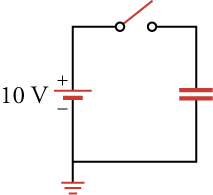
What is the voltage and current through the capacitor in the circuit below a long time after the switch is closed?

The figure shows a circuit with an open switch with one end connected to a capacitor. The other end of the capacitor is connected to the negative terminal of a 10-volt voltage source. The positive terminal of the voltage source is connected to the other end of the open switch. The connection between the capacitor and voltage source is also connected to the ground.
  1. 0 V, 0 A
  2. 0 V, 10 A
  3. 10 V, 0 A
  4. 10 V, 10 A

19.3 Parallel Circuits

7 .
If you remove resistance from a circuit, does the total resistance of the circuit always decrease? Explain.
  1. No, because for a parallel combination of resistors, the resistance through the remaining circuit increases.
  2. Yes, because for a parallel combination of resistors, the resistance through the remaining circuit increases.
8 .
Explain why the equivalent resistance of a parallel combination of resistors is always less than the smallest of the parallel resistors.
  1. Adding resistors in parallel gives the current a shorter path through which it can flow, hence decreasing the overall resistance.
  2. Adding resistors in parallel gives the current another path through which it can flow, hence decreasing the overall resistance.
  3. Adding resistors in parallel reduce the number of paths through which the current can flow, hence decreasing the overall resistance.
  4. Adding resistors in parallel gives the current a longer path through which it can flow, hence decreasing the overall resistance.

19.4 Electric Power

9.

To draw the most power from a battery, should you connect a small or a large resistance across its terminals? Explain.

  1. Small resistance, because smaller resistance will lead to the largest power
  2. Large resistance, because smaller resistance will lead to the largest power
10.

If you double the current through a resistor, by what factor does the power dissipated by the resistor change?

  1. Power increases by a factor of two.
  2. Power increases by a factor of four.
  3. Power increases by a factor of eight.
  4. Power increases by a factor of 16.