8.3
Simplify Rational Exponents
Learning Objectives
By the end of this section, you will be able to:
- Simplify expressions with
- Simplify expressions with
- Use the properties of exponents to simplify expressions with rational exponents
Be Prepared
8.7
Before you get started, take this readiness quiz.
Add:
If you missed this problem, review Example 1.28.
Be Prepared
8.8
Simplify:
If you missed this problem, review Example 5.18.
Be Prepared
8.9
Simplify:
If you missed this problem, review Example 5.14.
Simplify Expressions with
Rational exponents are another way of writing expressions with radicals. When we use rational exponents, we can apply the properties of exponents to simplify expressions.
The Power Property for Exponents says that when m and n are whole numbers. Let’s assume we are now not limited to whole numbers.
Suppose we want to find a number p such that We will use the Power Property of Exponents to find the value of p.
So But we know also Then it must be that
This same logic can be used for any positive integer exponent n to show that
Rational Exponent
If is a real number and then
The denominator of the rational exponent is the index of the radical.
There will be times when working with expressions will be easier if you use rational exponents and times when it will be easier if you use radicals. In the first few examples, you’ll practice converting expressions between these two notations.
Example
8.26
Write as a radical expression: ⓐ ⓑ ⓒ
Solution
We want to write each expression in the form
ⓐ
|
|
The denominator of the rational exponent is 2, so
the index of the radical is 2. We do not show the
index when it is 2. |
|
Illustrates the conversion of the rational exponent x^(1/2) to its radical form, sqrt(x), explaining the rule for the radical index.
ⓑ
|
|
The denominator of the exponent is 3, so the
index is 3. |
|
This table illustrates the conversion from fractional exponents to radical form, specifically demonstrating y^(1/3) as the cube root of y.
ⓒ
|
|
The denominator of the exponent is 4, so the
index is 4. |
|
This table illustrates the conversion of a fractional exponent to its equivalent radical form, focusing on how the exponent's denominator determines the radical index.
Try It
8.51
Write as a radical expression: ⓐ ⓑ ⓒ
Try It
8.52
Write as a radial expression: ⓐ ⓑ ⓒ
In the next example, we will write each radical using a rational exponent. It is important to use parentheses around the entire expression in the radicand since the entire expression is raised to the rational power.
Example
8.27
Write with a rational exponent: ⓐ ⓑ ⓒ
Solution
We want to write each radical in the form
ⓐ
|
|
No index is shown, so it is 2.
The denominator of the exponent will be 2. |
|
Put parentheses around the entire
expression |
|
Shows the conversion of a square root radical expression to its equivalent exponential form, with explanatory notes.
ⓑ
|
|
The index is 3, so the denominator of the
exponent is 3. Include parentheses |
|
This table illustrates converting a radical expression to its equivalent fractional exponent form, with an explanation of the underlying process.
ⓒ
|
|
The index is 4, so the denominator of the
exponent is 4. Put parentheses only around
the since 3 is not under the radical sign. |
|
Illustrates converting a radical expression to its rational exponent form, with detailed explanations.
Try It
8.53
Write with a rational exponent: ⓐ ⓑ ⓒ
Try It
8.54
Write with a rational exponent: ⓐ ⓑ ⓒ
In the next example, you may find it easier to simplify the expressions if you rewrite them as radicals first.
Example
8.28
Simplify: ⓐ ⓑ ⓒ
Solution
ⓐ
|
|
| Rewrite as a square root. |
|
| Simplify. |
|
Steps to simplify a fractional exponent: rewriting 25^(1/2) as a square root and finding its value.
ⓑ
|
|
| Rewrite as a cube root. |
|
| Recognize 64 is a perfect cube. |
|
| Simplify. |
|
This table illustrates the step-by-step simplification of 64 raised to the power of one-third, demonstrating its conversion to a cube root and final evaluation.
ⓒ
|
|
| Rewrite as a fourth root. |
|
| Recognize 256 is a perfect fourth power. |
|
| Simplify. |
|
This table illustrates the step-by-step simplification of the mathematical expression 256 to the power of 1/4, demonstrating its transformation into a fourth root and final numerical evaluation.
Try It
8.55
Simplify: ⓐ ⓑ ⓒ
Try It
8.56
Simplify: ⓐ ⓑ ⓒ
Be careful of the placement of the negative signs in the next example. We will need to use the property in one case.
Example
8.29
Simplify: ⓐ ⓑ ⓒ
Solution
ⓐ
|
|
| Rewrite as a fourth root. |
|
|
|
| Simplify. |
|
This table illustrates the step-by-step simplification of the expression (-16)^(1/4), demonstrating the process to determine there is no real solution.
ⓑ
|
|
The exponent only applies to the 16.
Rewrite as a fouth root. |
|
| Rewrite 16 as |
|
| Simplify. |
|
Step-by-step simplification of the mathematical expression -16^(1/4), detailing each transformation to reach the final result.
ⓒ
|
|
| Rewrite using the property |
|
| Rewrite as a fourth root. |
|
| Rewrite 16 as |
|
| Simplify. |
|
Demonstrates the step-by-step simplification of (16)^(-1/4), converting it to 1/2 using exponent and root properties.
Try It
8.57
Simplify: ⓐ ⓑ ⓒ
Try It
8.58
Simplify: ⓐ ⓑ ⓒ
Simplify Expressions with
We can look at in two ways. Remember the Power Property tells us to multiply the exponents and so and both equal If we write these expressions in radical form, we get
This leads us to the following definition.
Rational Exponent
For any positive integers m and n,
Which form do we use to simplify an expression? We usually take the root first—that way we keep the numbers in the radicand smaller, before raising it to the power indicated.
Example
8.30
Write with a rational exponent: ⓐ ⓑ ⓒ
Solution
We want to use to write each radical in the form
ⓐ
ⓑ
ⓒ
Try It
8.59
Write with a rational exponent: ⓐ ⓑ ⓒ
Try It
8.60
Write with a rational exponent: ⓐ ⓑ ⓒ
Remember that The negative sign in the exponent does not change the sign of the expression.
Example
8.31
Simplify: ⓐ ⓑ ⓒ
Solution
We will rewrite the expression as a radical first using the defintion, This form lets us take the root first and so we keep the numbers in the radicand smaller than if we used the other form.
ⓐ
|
|
The power of the radical is the numerator of the exponent, 2.
The index of the radical is the denominator of the
exponent, 3. |
|
| Simplify. |
|
|
|
Step-by-step simplification of an expression with a fractional exponent by converting it to radical form.
ⓑ We will rewrite each expression first using and then change to radical form.
|
|
| Rewrite using |
|
Change to radical form. The power of the radical is the
numerator of the exponent, 3. The index is the denominator
of the exponent, 2. |
|
| Simplify. |
|
|
|
Steps for simplifying the exponential expression 16^(-3/2) using exponent and radical rules.
ⓒ
|
|
| Rewrite using |
|
| Change to radical form. |
|
| Rewrite the radicand as a power. |
|
| Simplify. |
|
|
|
Step-by-step simplification of 32^(-2/5), illustrating conversion from negative fractional exponent to radical form and final evaluation.
Try It
8.61
Simplify: ⓐ ⓑ ⓒ
Try It
8.62
Simplify: ⓐ ⓑ ⓒ
Example
8.32
Simplify: ⓐ ⓑ ⓒ
Solution
ⓐ
|
|
| Rewrite in radical form. |
|
| Simplify the radical. |
|
| Simplify. |
|
Step-by-step simplification of a negative number raised to a fractional exponent.
ⓑ
|
|
| Rewrite using |
|
| Rewrite in radical form. |
|
| Simplify the radical. |
|
| Simplify. |
|
Step-by-step simplification of the expression -25^(-3/2) using exponent rules, radical forms, and arithmetic operations.
ⓒ
|
|
| Rewrite in radical form. |
|
There is no real number whose square root
|
|
Evaluates the expression (-25)^(3/2), demonstrating the steps to rewrite it in radical form and concluding that it is not a real number.
Try It
8.63
Simplify: ⓐ ⓑ ⓒ
Try It
8.64
Simplify: ⓐ ⓑ ⓒ
Use the Properties of Exponents to Simplify Expressions with Rational Exponents
The same properties of exponents that we have already used also apply to rational exponents. We will list the Properties of Exponenets here to have them for reference as we simplify expressions.
Properties of Exponents
If a and b are real numbers and m and n are rational numbers, then
We will apply these properties in the next example.
Example
8.33
Simplify: ⓐ ⓑ ⓒ
Solution
ⓐ The Product Property tells us that when we multiply the same base, we add the exponents.
|
|
The bases are the same, so we add the
exponents. |
|
| Add the fractions. |
|
| Simplify the exponent. |
|
This table demonstrates the step-by-step simplification of an algebraic expression involving fractional exponents by applying the rule for multiplying powers with the same base.
ⓑ The Power Property tells us that when we raise a power to a power, we multiply the exponents.
|
|
To raise a power to a power, we multiply
the exponents. |
|
| Simplify. |
|
Steps for simplifying an exponential expression using the power of a power rule, showing the rule's application and the final result.
ⓒ The Quotient Property tells us that when we divide with the same base, we subtract the exponents.
|
|
|
|
To divide with the same base, we subtract
the exponents. |
|
| Simplify. |
|
This table demonstrates the step-by-step simplification of an exponential expression using the quotient rule for exponents.
Try It
8.65
Simplify: ⓐ ⓑ ⓒ
Try It
8.66
Simplify: ⓐ ⓑ ⓒ
Sometimes we need to use more than one property. In the next example, we will use both the Product to a Power Property and then the Power Property.
Example
8.34
Simplify: ⓐ ⓑ
Solution
ⓐ
|
|
First we use the Product to a Power
Property. |
|
| Rewrite 27 as a power of 3. |
|
To raise a power to a power, we multiply
the exponents. |
|
| Simplify. |
|
Step-by-step simplification of an algebraic expression involving fractional exponents using exponent properties.
ⓑ
|
|
First we use the Product to a Power
Property. |
|
To raise a power to a power, we multiply
the exponents. |
|
This table illustrates the step-by-step simplification of an algebraic expression involving fractional exponents and the product to a power property.
Try It
8.67
Simplify: ⓐ ⓑ
Try It
8.68
Simplify: ⓐ ⓑ
We will use both the Product Property and the Quotient Property in the next example.
Example
8.35
Simplify: ⓐ ⓑ
Solution
ⓐ
|
|
Use the Product Property in the numerator,
add the exponents. |
|
Use the Quotient Property, subtract the
exponents. |
|
| Simplify. |
|
Step-by-step simplification of a rational expression using the Product and Quotient Properties of exponents.
ⓑ Follow the order of operations to simplify inside the parenthese first.
|
|
Use the Quotient Property, subtract the
exponents. |
|
| Simplify. |
|
Use the Product to a Power Property,
multiply the exponents. |
|
Step-by-step simplification of an algebraic expression involving fractional exponents using properties of exponents.
Try It
8.69
Simplify: ⓐ ⓑ
Try It
8.70
Simplify: ⓐ ⓑ
Section 8.3 Exercises
Practice Makes Perfect
Simplify expressions with
In the following exercises, write as a radical expression.
119.
ⓐ ⓑ ⓒ
120.
ⓐ ⓑ ⓒ
121.
ⓐ ⓑ ⓒ
122.
ⓐ ⓑ ⓒ
In the following exercises, write with a rational exponent.
125.
ⓐ ⓑ ⓒ
126.
ⓐ ⓑ ⓒ
127.
ⓐ ⓑ ⓒ
128.
ⓐ ⓑ ⓒ
In the following exercises, simplify.
129.
ⓐ ⓑ ⓒ
130.
ⓐ ⓑ ⓒ
131.
ⓐ ⓑ ⓒ
132.
ⓐ ⓑ ⓒ
133.
ⓐ ⓑ ⓒ
134.
ⓐ ⓑ ⓒ
135.
ⓐ ⓑ ⓒ
136.
ⓐ ⓑ ⓒ
137.
ⓐ ⓑ ⓒ
138.
ⓐ ⓑ ⓒ
139.
ⓐ ⓑ ⓒ
140.
ⓐ ⓑ ⓒ
Simplify Expressions with
In the following exercises, write with a rational exponent.
141.
ⓐ ⓑ ⓒ
142.
ⓐ ⓑ ⓒ
143.
ⓐ ⓑ ⓒ
144.
ⓐ ⓑ ⓒ
In the following exercises, simplify.
145.
ⓐ ⓑ ⓒ
146.
ⓐ ⓑ ⓒ
147.
ⓐ ⓑ ⓒ
148.
ⓐ ⓑ ⓒ
149.
ⓐ ⓑ ⓒ
150.
ⓐ ⓑ ⓒ
Use the Laws of Exponents to Simplify Expressions with Rational Exponents
In the following exercises, simplify. Assume all variables are positive.
151.
ⓐ ⓑ ⓒ
152.
ⓐ ⓑ ⓒ
153.
ⓐ ⓑ ⓒ
154.
ⓐ ⓑ ⓒ
155.
ⓐ ⓑ
156.
ⓐ ⓑ
157.
ⓐ ⓑ
158.
ⓐ ⓑ
159.
ⓐ ⓑ
160.
ⓐ ⓑ
161.
ⓐ ⓑ
162.
ⓐ ⓑ
Writing Exercises
163.
Show two different algebraic methods to simplify Explain all your steps.
164.
Explain why the expression cannot be evaluated.
Self Check
ⓐ After completing the exercises, use this checklist to evaluate your mastery of the objectives of this section.
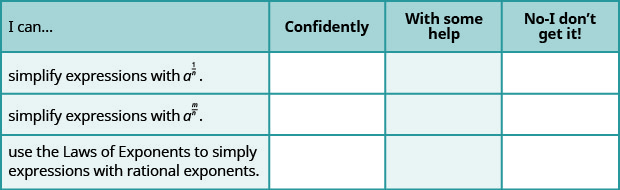
ⓑ What does this checklist tell you about your mastery of this section? What steps will you take to improve?