Chapter 7

Chapter 7

Checkpoint

7.1
  1. Nonlinear
  2. Linear, nonhomogeneous
7.4

Linearly independent

7.5

y ( x ) = c 1 e 3 x + c 2 x e 3 x y ( x ) = c 1 e 3 x + c 2 x e 3 x

7.6
  1. y(x)=ex(c1cos3x+c2sin3x)y(x)=ex(c1cos3x+c2sin3x)
  2. y(x)=c1e−7x+c2xe−7xy(x)=c1e−7x+c2xe−7x
7.7

y ( x ) = − e −2 x + e 5 x y ( x ) = − e −2 x + e 5 x

7.8

y(x)=ex(2cos3x−sin3x)y(x)=ex(2cos3x−sin3x)

This figure is the graph of y(x) = e^x(2 cos 3x − sin 3x) It has the positive x axis scaled in increments of even tenths. The y axis is scaled in increments of twenty. The graph itself starts at the origin. Its amplitude increases as x increases.
7.9

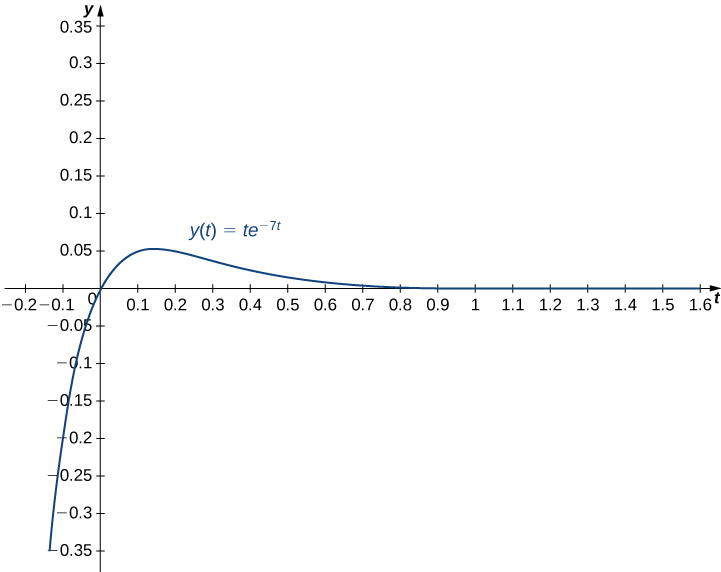
y(t)=te−7ty(t)=te−7t

This figure is the graph of y(t) = te^−7t. The horizontal axis is labeled with t and is scaled in increments of tenths. The y axis is scaled in increments of 0.5. The graph passes through the origin and has a horizontal asymptote of the positive t axis.


At time t=0.3,t=0.3, y(0.3)=0.3e(−7*0.3)=0.3e−2.1≈0.0367.y(0.3)=0.3e(−7*0.3)=0.3e−2.1≈0.0367. The mass is 0.0367 ft below equilibrium. At time t=0.1,t=0.1, y′(0.1)=0.3e−0.7≈0.1490.y′(0.1)=0.3e−0.7≈0.1490. The mass is moving downward at a speed of 0.1490 ft/sec.

7.10

y ( x ) = c 1 e − x + c 2 e 4 x − 2 y ( x ) = c 1 e − x + c 2 e 4 x − 2

7.11

y ( t ) = c 1 e 2 t + c 2 t e 2 t + sin t + cos t y ( t ) = c 1 e 2 t + c 2 t e 2 t + sin t + cos t

7.12
  1. y(x)=c1e4x+c2ex−xexy(x)=c1e4x+c2ex−xex
  2. y(t)=c1e−3t+c2e2t−5cos2t+sin2ty(t)=c1e−3t+c2e2t−5cos2t+sin2t
7.13

z1=3x+311x2,z1=3x+311x2, z2=2x+211xz2=2x+211x

7.14
  1. y(x)=c1cosx+c2sinx+cosxln|cosx|+xsinxy(x)=c1cosx+c2sinx+cosxln|cosx|+xsinx
  2. x(t)=c1et+c2tet+tetln|t|x(t)=c1et+c2tet+tetln|t|
7.15

x(t)=0.1cos(14t)x(t)=0.1cos(14t) (in meters); frequency is 142π142π Hz.

7.16

x(t)=17sin(4t+0.245),x(t)=17sin(4t+0.245), frequency=42π≈0.637,frequency=42π≈0.637, A=17A=17

7.17

x ( t ) = 0.6 e −2 t − 0.2 e −6 t x ( t ) = 0.6 e −2 t − 0.2 e −6 t

7.18

x ( t ) = 1 2 e −8 t + 4 t e −8 t x ( t ) = 1 2 e −8 t + 4 t e −8 t

7.19

x ( t ) = −0.24 e −2 t cos ( 4 t ) − 0.12 e −2 t sin ( 4 t ) x ( t ) = −0.24 e −2 t cos ( 4 t ) − 0.12 e −2 t sin ( 4 t )

7.20

x(t)=−12cos(4t)+94sin(4t)+12e−2tcos(4t)−2e−2tsin(4t)x(t)=−12cos(4t)+94sin(4t)+12e−2tcos(4t)−2e−2tsin(4t)
Transient solution:12e−2tcos(4t)−2e−2tsin(4t)Transient solution:12e−2tcos(4t)−2e−2tsin(4t)
Steady-state solution:−12cos(4t)+94sin(4t)Steady-state solution:−12cos(4t)+94sin(4t)

7.21

q ( t ) = −25 e − t cos ( 3 t ) − 7 e − t sin ( 3 t ) + 25 q ( t ) = −25 e − t cos ( 3 t ) − 7 e − t sin ( 3 t ) + 25

7.22
  1. y(x)=a0∑n=0∞(−1)nn!x2n=a0e−x2y(x)=a0∑n=0∞(−1)nn!x2n=a0e−x2
  2. y(x)=a0(x+1)3y(x)=a0(x+1)3

Section 7.1 Exercises

1.

linear, homogenous

3.

nonlinear

5.

linear, homogeneous

11.

y = c 1 e 5 x + c 2 e −2 x y = c 1 e 5 x + c 2 e −2 x

13.

y = c 1 e −2 x + c 2 x e −2 x y = c 1 e −2 x + c 2 x e −2 x

15.

y = c 1 e 5 x / 2 + c 2 e − x y = c 1 e 5 x / 2 + c 2 e − x

17.

y = e − x / 2 ( c 1 cos 3 x 2 + c 2 sin 3 x 2 ) y = e − x / 2 ( c 1 cos 3 x 2 + c 2 sin 3 x 2 )

19.

y = c 1 e −11 x + c 2 e 11 x y = c 1 e −11 x + c 2 e 11 x

21.

y = c 1 cos 9 x + c 2 sin 9 x y = c 1 cos 9 x + c 2 sin 9 x

23.

y = c 1 + c 2 x y = c 1 + c 2 x

25.

y = c 1 e ( ( 1 + 22 ) / 3 ) x + c 2 e ( ( 1 − 22 ) / 3 ) x y = c 1 e ( ( 1 + 22 ) / 3 ) x + c 2 e ( ( 1 − 22 ) / 3 ) x

27.

y = c 1 e − x / 6 + c 2 x e − x / 6 y = c 1 e − x / 6 + c 2 x e − x / 6

29.

y = c 1 + c 2 e 9 x y = c 1 + c 2 e 9 x

31.

y = −2 e −2 x + 2 e −3 x y = −2 e −2 x + 2 e −3 x

33.

y = 3 cos ( 2 x ) + 5 sin ( 2 x ) y = 3 cos ( 2 x ) + 5 sin ( 2 x )

35.

y = − e 6 x + 2 e −5 x y = − e 6 x + 2 e −5 x

37.

y = 2 e − x / 5 + 7 5 x e − x / 5 y = 2 e − x / 5 + 7 5 x e − x / 5

39.

y = ( 2 e 6 − e −7 ) e 6 x − ( 2 e 6 − e −7 ) e −7 x y = ( 2 e 6 − e −7 ) e 6 x − ( 2 e 6 − e −7 ) e −7 x

41.

No solutions exist.

43.

y = 2 e 2 x − 2 e 2 + 1 e 2 x e 2 x y = 2 e 2 x − 2 e 2 + 1 e 2 x e 2 x

45.

y = 4 cos 3 x + c 2 sin 3 x , infinitely many solutions y = 4 cos 3 x + c 2 sin 3 x , infinitely many solutions

47.

5 y ″ + 19 y ′ − 4 y = 0 5 y ″ + 19 y ′ − 4 y = 0

49.

a. y=3cos(8x)y=3cos(8x)
b.

This figure is a periodic graph. It has an amplitude of 3.5. Both the x and y axes are scaled in increments of 1.
51.

a. y=e(−5/2)x[−2cos(352x)+43535sin(352x)]y=e(−5/2)x[−2cos(352x)+43535sin(352x)]
b.

This figure is a graph of an oscillating function. The amplitude of the graph is decreasing as x increases.

Section 7.2 Exercises

55.

y = c 1 e −4 x / 3 + c 2 e x − 2 y = c 1 e −4 x / 3 + c 2 e x − 2

57.

y = c 1 cos 4 x + c 2 sin 4 x + 1 20 e −2 x y = c 1 cos 4 x + c 2 sin 4 x + 1 20 e −2 x

59.

y = c 1 e 2 x + c 2 x e 2 x + 2 x 2 + 5 x + 4 y = c 1 e 2 x + c 2 x e 2 x + 2 x 2 + 5 x + 4

61.

y = c 1 e − x + c 2 x e − x + 1 2 sin x − 1 2 cos x y = c 1 e − x + c 2 x e − x + 1 2 sin x − 1 2 cos x

63.

y = c 1 cos x + c 2 sin x − 1 3 x cos 2 x − 5 9 sin 2 x y = c 1 cos x + c 2 sin x − 1 3 x cos 2 x − 5 9 sin 2 x

65.

y = c 1 e −5 x + c 2 x e −5 x + 1 6 x 3 e −5 x + 4 25 y = c 1 e −5 x + c 2 x e −5 x + 1 6 x 3 e −5 x + 4 25

67.

a. yp(x)=Ax2+Bx+Cyp(x)=Ax2+Bx+C
b. yp(x)=−13x2+43x−359yp(x)=−13x2+43x−359

69.

a. yp(x)=(Ax2+Bx+C)e−xyp(x)=(Ax2+Bx+C)e−x
b. yp(x)=(14x2−58x−3332)e−xyp(x)=(14x2−58x−3332)e−x

71.

a. yp(x)=(Ax2+Bx+C)excosxyp(x)=(Ax2+Bx+C)excosx +(Dx2+Ex+F)exsinx+(Dx2+Ex+F)exsinx
b. yp(x)=(−110x2−1125x−27250)excosxyp(x)=(−110x2−1125x−27250)excosx +(−310x2+225x+39250)exsinx+(−310x2+225x+39250)exsinx

73.

y = c 1 + c 2 e −2 x + 1 15 e 3 x y = c 1 + c 2 e −2 x + 1 15 e 3 x

75.

y = c 1 e 2 x + c 2 e −4 x + x e 2 x y = c 1 e 2 x + c 2 e −4 x + x e 2 x

77.

y = c 1 e 3 x + c 2 e −3 x − 8 x 9 y = c 1 e 3 x + c 2 e −3 x − 8 x 9

79.

y = c 1 cos 2 x + c 2 sin 2 x − 3 2 x cos 2 x + 3 4 sin 2 x ln ( sin 2 x ) y = c 1 cos 2 x + c 2 sin 2 x − 3 2 x cos 2 x + 3 4 sin 2 x ln ( sin 2 x )

81.

y = − 347 343 + 4 343 e 7 x + 2 7 x 2 e 7 x − 4 49 x e 7 x y = − 347 343 + 4 343 e 7 x + 2 7 x 2 e 7 x − 4 49 x e 7 x

83.

y = − 57 25 + 3 25 e 5 x + 1 5 x e 5 x + 4 25 e −5 x y = − 57 25 + 3 25 e 5 x + 1 5 x e 5 x + 4 25 e −5 x

85.

y p = 1 2 + 10 3 x 2 ln x y p = 1 2 + 10 3 x 2 ln x

Section 7.3 Exercises

87.

x″+16x=0,x″+16x=0, x(t)=16cos(4t)−2sin(4t),x(t)=16cos(4t)−2sin(4t), period =π2sec,=π2sec, frequency =2πHz=2πHz

89.

x″+196x=0,x″+196x=0, x(t)=0.15cos(14t),x(t)=0.15cos(14t), period =π7sec,=π7sec, frequency =7πHz=7πHz

91.

a. x(t)=5sin(2t)x(t)=5sin(2t)
b. period =πsec,=πsec, frequency =1πHz=1πHz
c.

This figure is the graph of a function. It is a periodic function with consistent amplitude. The horizontal axis is labeled in increments of 1. The vertical axis is labeled in increments of 1.5.


d. t=π2sect=π2sec

93.

a. x(t)=e−t/5(20cos(3t)+15sin(3t))x(t)=e−t/5(20cos(3t)+15sin(3t))
b. underdamped

95.

a. x(t)=e−4t(–5cos11.866t – 0.834sin11.866t)x(t)=e−4t(–5cos11.866t – 0.834sin11.866t)
b. underdamped

97.

x(π)=7e−π/46x(π)=7e−π/46 ft below

99.

x ( t ) = 1 2 cos ( 8 2 t ) – 4 2 21 sin 8 2 t + 8 21 sin 8 2 t x ( t ) = 1 2 cos ( 8 2 t ) – 4 2 21 sin 8 2 t + 8 21 sin 8 2 t

101.

q ( t ) = e −6 t ( 0.051 cos ( 8 t ) + 0.03825 sin ( 8 t ) ) − 1 20 cos ( 10 t ) q ( t ) = e −6 t ( 0.051 cos ( 8 t ) + 0.03825 sin ( 8 t ) ) − 1 20 cos ( 10 t )

103.

q ( t ) = e −10 t ( −32 t − 5 ) + 5 , I ( t ) = 2 e −10 t ( 160 t + 9 ) q ( t ) = e −10 t ( −32 t − 5 ) + 5 , I ( t ) = 2 e −10 t ( 160 t + 9 )

Section 7.4 Exercises

105.

y = a 0 + 5 a 1 ∑ n = 1 ∞ ( − x / 5 ) n n ! = c 0 + 5 c 1 e − x / 5 y = a 0 + 5 a 1 ∑ n = 1 ∞ ( − x / 5 ) n n ! = c 0 + 5 c 1 e − x / 5

107.

y = a 0 ∑ n = 0 ∞ ( x ) 2 n ( 2 n ) ! + a 1 ∑ n = 0 ∞ ( x ) 2 n + 1 ( 2 n + 1 ) ! y = a 0 ∑ n = 0 ∞ ( x ) 2 n ( 2 n ) ! + a 1 ∑ n = 0 ∞ ( x ) 2 n + 1 ( 2 n + 1 ) !

109.

y = a 0 ∑ n = 0 ∞ x 2 n n ! = c 0 e x 2 y = a 0 ∑ n = 0 ∞ x 2 n n ! = c 0 e x 2

111.

y = a 0 ∑ n = 0 ∞ x 2 n 2 n n ! + a 1 ∑ n = 0 ∞ x 2 n + 1 1 ⋅ 3 ⋅ 5 ⋅ 7 ⋯ ( 2 n + 1 ) y = a 0 ∑ n = 0 ∞ x 2 n 2 n n ! + a 1 ∑ n = 0 ∞ x 2 n + 1 1 ⋅ 3 ⋅ 5 ⋅ 7 ⋯ ( 2 n + 1 )

113.

y = c 0 x 3 + c 1 x y = c 0 x 3 + c 1 x

115.

y = 1 − 3 x + 2 x 3 3 ! − 12 x 4 4 ! + 16 x 6 6 ! − 120 x 7 7 ! + ⋯ y = 1 − 3 x + 2 x 3 3 ! − 12 x 4 4 ! + 16 x 6 6 ! − 120 x 7 7 ! + ⋯

Review Exercises

117.

True

119.

False

121.

second order, linear, homogeneous, λ2−2=0λ2−2=0

123.

first order, nonlinear, nonhomogeneous

125.

y = c 1 cos ( 3 x ) + c 2 sin ( 3 x ) y = c 1 cos ( 3 x ) + c 2 sin ( 3 x )

127.

y = c 1 e x cos ( 3 x ) + c 2 e x sin ( 3 x ) + 2 5 x + 2 25 y = c 1 e x cos ( 3 x ) + c 2 e x sin ( 3 x ) + 2 5 x + 2 25

129.

y = c 1 e − x + c 2 e −4 x + x 4 + e 2 x 18 − 5 16 y = c 1 e − x + c 2 e −4 x + x 4 + e 2 x 18 − 5 16

131.

y = c 1 e ( −3 / 2 ) x + c 2 x e ( −3 / 2 ) x + 4 9 x 2 + 4 27 x − 16 27 y = c 1 e ( −3 / 2 ) x + c 2 x e ( −3 / 2 ) x + 4 9 x 2 + 4 27 x − 16 27

133.

y = e −2 x sin ( 2 x ) y = e −2 x sin ( 2 x )

135.

y = e 1 − x e 4 − 1 ( e 4 x − 1 ) y = e 1 − x e 4 − 1 ( e 4 x − 1 )

137.

θ ( t ) = θ 0 cos ( g l L ) θ ( t ) = θ 0 cos ( g l L )

141.

b = a b = a