Series Solutions of Differential Equations

7.4 Series Solutions of Differential Equations

Learning Objectives

  • 7.4.1 Use power series to solve first-order and second-order differential equations.

In Introduction to Power Series, we studied how functions can be represented as power series, y(x)=∑n=0∞anxn.y(x)=∑n=0∞anxn. We also saw that we can find series representations of the derivatives of such functions by differentiating the power series term by term. This gives y′(x)=∑n=1∞nanxn−1y′(x)=∑n=1∞nanxn−1 and y″(x)=∑n=2∞n(n−1)anxn−2.y″(x)=∑n=2∞n(n−1)anxn−2. In some cases, these power series representations can be used to find solutions to differential equations.

Be aware that this subject is given only a very brief treatment in this text. Most introductory differential equations textbooks include an entire chapter on power series solutions. This text has only a single section on the topic, so several important issues are not addressed here, particularly issues related to existence of solutions. The examples and exercises in this section were chosen for which power solutions exist. However, it is not always the case that power solutions exist. Those of you interested in a more rigorous treatment of this topic should consult a differential equations text.

Problem-Solving Strategy

Finding Power Series Solutions to Differential Equations

  1. Assume the differential equation has a solution of the form y(x)=∑n=0∞anxn.y(x)=∑n=0∞anxn.
  2. Differentiate the power series term by term to get y′(x)=∑n=1∞nanxn−1y′(x)=∑n=1∞nanxn−1 and y″(x)=∑n=2∞n(n−1)anxn−2.y″(x)=∑n=2∞n(n−1)anxn−2.
  3. Substitute the power series expressions into the differential equation.
  4. Re-index sums as necessary to combine terms and simplify the expression.
  5. Equate coefficients of like powers of xx to determine values for the coefficients anan in the power series.
  6. Substitute the coefficients back into the power series and write the solution.

Example 7.25

Series Solutions to Differential Equations

Find a power series solution for the following differential equations.

  1. y″−y=0y″−y=0
  2. (x2−1)y″+6xy′+4y=−4(x2−1)y″+6xy′+4y=−4

Solution

  1. Assume y(x)=∑n=0∞anxny(x)=∑n=0∞anxn (step 1). Then, y′(x)=∑n=1∞nanxn−1y′(x)=∑n=1∞nanxn−1 and y″(x)=∑n=2∞n(n−1)anxn−2y″(x)=∑n=2∞n(n−1)anxn−2 (step 2). We want to find values for the coefficients anan such that
    y″−y=0∑n=2∞n(n−1)anxn−2−∑n=0∞anxn=0(step 3).y″−y=0∑n=2∞n(n−1)anxn−2−∑n=0∞anxn=0(step 3).

    We want the indices on our sums to match so that we can express them using a single summation. That is, we want to rewrite the first summation so that it starts with n=0.n=0.
    To re-index the first term, replace n with n+2n+2 inside the sum, and change the lower summation limit to n=0.n=0. We get
    ∑n=2∞n(n−1)anxn−2=∑n=0∞(n+2)(n+1)an+2xn.∑n=2∞n(n−1)anxn−2=∑n=0∞(n+2)(n+1)an+2xn.

    This gives
    ∑n=0∞(n+2)(n+1)an+2xn−∑n=0∞anxn=0∑n=0∞[(n+2)(n+1)an+2−an]xn=0(step 4).∑n=0∞(n+2)(n+1)an+2xn−∑n=0∞anxn=0∑n=0∞[(n+2)(n+1)an+2−an]xn=0(step 4).

    Because power series expansions of functions are unique, this equation can be true only if the coefficients of each power of x are zero. So we have
    (n+2)(n+1)an+2−an=0forn=0,1,2,….(n+2)(n+1)an+2−an=0forn=0,1,2,….

    This recurrence relationship allows us to express each coefficient anan in terms of the coefficient two terms earlier. This yields one expression for even values of n and another expression for odd values of n. Looking first at the equations involving even values of n, we see that
    a2=a02a4=a24⋅3=a04!a6=a46⋅5=a06!⋮.a2=a02a4=a24⋅3=a04!a6=a46⋅5=a06!⋮.

    Thus, in general, when n is even, an=a0n!an=a0n! (step 5).
    For the equations involving odd values of n, we see that
    a3=a13⋅2=a13!a5=a35⋅4=a15!a7=a57⋅6=a17!⋮.a3=a13⋅2=a13!a5=a35⋅4=a15!a7=a57⋅6=a17!⋮.

    Therefore, in general, when n is odd, an=a1n!an=a1n! (step 5 continued).
    Putting this together, we have
    y(x)=∑n=0∞anxn=a0+a1x+a02x2+a13!x3+a04!x4+a15!x5+⋯.y(x)=∑n=0∞anxn=a0+a1x+a02x2+a13!x3+a04!x4+a15!x5+⋯.

    Re-indexing the sums to account for the even and odd values of n separately, we obtain
    y(x)=a0∑k=0∞1(2k)!x2k+a1∑k=0∞1(2k+1)!x2k+1(step 6).y(x)=a0∑k=0∞1(2k)!x2k+a1∑k=0∞1(2k+1)!x2k+1(step 6).

    Analysis for part a.
    As expected for a second-order differential equation, this solution depends on two arbitrary constants. However, note that our differential equation is a constant-coefficient differential equation, yet the power series solution does not appear to have the familiar form (containing exponential functions) that we are used to seeing. Furthermore, since y(x)=c1ex+c2e−xy(x)=c1ex+c2e−x is the general solution to this equation, we must be able to write any solution in this form, and it is not clear whether the power series solution we just found can, in fact, be written in that form.
    Fortunately, after writing the power series representations of exex and e−x,e−x, and doing some algebra, we find that if we choose
    c0=(a0+a1)2, c1=(a0−a1)2,c0=(a0+a1)2, c1=(a0−a1)2,

    we then have a0=c0+c1a0=c0+c1 anda1=c0−c1,a1=c0−c1, and
    y(x)=a0+a1x+a02x2+a13!x3+a04!x4+a15!x5+⋯=(c0+c1)+(c0−c1)x+(c0+c1)2x2+(c0−c1)3!x3+(c0+c1)4!x4+(c0−c1)5!x5+⋯=c0∑n=0∞xnn!+c1∑n=0∞(−x)nn!=c0ex+c1e−x.y(x)=a0+a1x+a02x2+a13!x3+a04!x4+a15!x5+⋯=(c0+c1)+(c0−c1)x+(c0+c1)2x2+(c0−c1)3!x3+(c0+c1)4!x4+(c0−c1)5!x5+⋯=c0∑n=0∞xnn!+c1∑n=0∞(−x)nn!=c0ex+c1e−x.

    So we have, in fact, found the same general solution. Note that this choice of c1c1 and c2c2 is not obvious. This is a case when we know what the answer should be, and have essentially “reverse-engineered” our choice of coefficients.
  2. Assume y(x)=∑n=0∞anxny(x)=∑n=0∞anxn (step 1). Then, y′(x)=∑n=1∞nanxn−1y′(x)=∑n=1∞nanxn−1 and y″(x)=∑n=2∞n(n−1)anxn−2y″(x)=∑n=2∞n(n−1)anxn−2 (step 2). We want to find values for the coefficients anan such that
    (x2−1)y″+6xy′+4y=−4(x2−1)∑n=2∞n(n−1)anxn−2+6x∑n=1∞nanxn−1+4∑n=0∞anxn=−4x2∑n=2∞n(n−1)anxn−2−∑n=2∞n(n−1)anxn−2+6x∑n=1∞nanxn−1+4∑n=0∞anxn=−4.(x2−1)y″+6xy′+4y=−4(x2−1)∑n=2∞n(n−1)anxn−2+6x∑n=1∞nanxn−1+4∑n=0∞anxn=−4x2∑n=2∞n(n−1)anxn−2−∑n=2∞n(n−1)anxn−2+6x∑n=1∞nanxn−1+4∑n=0∞anxn=−4.

    Taking the external factors inside the summations, we get
    ∑n=2∞n(n−1)anxn−∑n=2∞n(n−1)anxn−2+∑n=1∞6nanxn+∑n=0∞4anxn=−4(step 3).∑n=2∞n(n−1)anxn−∑n=2∞n(n−1)anxn−2+∑n=1∞6nanxn+∑n=0∞4anxn=−4(step 3).

    Now, in the first summation, we see that when n=0n=0 or n=1,n=1, the term evaluates to zero, so we can add these terms back into our sum to get
    ∑n=2∞n(n−1)anxn=∑n=0∞n(n−1)anxn.∑n=2∞n(n−1)anxn=∑n=0∞n(n−1)anxn.

    Similarly, in the third term, we see that when n=0,n=0, the expression evaluates to zero, so we can add that term back in as well. We have
    ∑n=1∞6nanxn=∑n=0∞6nanxn.∑n=1∞6nanxn=∑n=0∞6nanxn.

    Then, we need only shift the indices in our second term. We get
    ∑n=2∞n(n−1)anxn−2=∑n=0∞(n+2)(n+1)an+2xn.∑n=2∞n(n−1)anxn−2=∑n=0∞(n+2)(n+1)an+2xn.

    Thus, we have
    ∑n=0∞n(n−1)anxn−∑n=0∞(n+2)(n+1)an+2xn+∑n=0∞6nanxn+∑n=0∞4anxn=−4(step 4).∑n=0∞[n(n−1)an−(n+2)(n+1)an+2+6nan+4an]xn=−4∑n=0∞[(n2−n)an+6nan+4an−(n+2)(n+1)an+2]xn=−4∑n=0∞[n2an+5nan+4an−(n+2)(n+1)an+2]xn=−4∑n=0∞[(n2+5n+4)an−(n+2)(n+1)an+2]xn=−4∑n=0∞[(n+4)(n+1)an−(n+2)(n+1)an+2]xn=−4∑n=0∞n(n−1)anxn−∑n=0∞(n+2)(n+1)an+2xn+∑n=0∞6nanxn+∑n=0∞4anxn=−4(step 4).∑n=0∞[n(n−1)an−(n+2)(n+1)an+2+6nan+4an]xn=−4∑n=0∞[(n2−n)an+6nan+4an−(n+2)(n+1)an+2]xn=−4∑n=0∞[n2an+5nan+4an−(n+2)(n+1)an+2]xn=−4∑n=0∞[(n2+5n+4)an−(n+2)(n+1)an+2]xn=−4∑n=0∞[(n+4)(n+1)an−(n+2)(n+1)an+2]xn=−4

    Looking at the coefficients of each power of x, we see that the constant term must be equal to −4,−4, and the coefficients of all other powers of x must be zero. Then, looking first at the constant term,
    4a0−2a2=−4a2=2a0+2(step 3).4a0−2a2=−4a2=2a0+2(step 3).

    For n≥1,n≥1, we have
    (n+4)(n+1)an−(n+2)(n+1)an+2=0(n+1)[(n+4)an−(n+2)an+2]=0.(n+4)(n+1)an−(n+2)(n+1)an+2=0(n+1)[(n+4)an−(n+2)an+2]=0.

    Since n≥1,n≥1, n+1≠0,n+1≠0, we see that
    (n+4)an−(n+2)an+2=0(n+4)an−(n+2)an+2=0

    and thus
    an+2=n+4n+2an.an+2=n+4n+2an.

    For even values of n, we have
    a4=64(2a0+2)=3a0+3a6=86(3a0+3)=4a0+4⋮.a4=64(2a0+2)=3a0+3a6=86(3a0+3)=4a0+4⋮.

    In general, a2k=(k+1)(a0+1)a2k=(k+1)(a0+1) (step 5).
    For odd values of n, we have
    a3=53a1a5=75a3=73a1a7=97a5=93a1=3a1⋮.a3=53a1a5=75a3=73a1a7=97a5=93a1=3a1⋮.

    In general, a2k+1=2k+33a1a2k+1=2k+33a1 (step 5 continued).
    Putting this together, we have
    y(x)=∑k=0∞(k+1)(a0+1)x2k+∑k=0∞(2k+33)a1x2k+1(step 6).y(x)=∑k=0∞(k+1)(a0+1)x2k+∑k=0∞(2k+33)a1x2k+1(step 6).

Checkpoint 7.22

Find a power series solution for the following differential equations.

  1. y′+2xy=0y′+2xy=0
  2. (x+1)y′=3y(x+1)y′=3y

We close this section with a brief introduction to Bessel functions. Complete treatment of Bessel functions is well beyond the scope of this course, but we get a little taste of the topic here so we can see how series solutions to differential equations are used in real-world applications. The Bessel equation of order n is given by

x2y″+xy′+(x2−n2)y=0.x2y″+xy′+(x2−n2)y=0.

This equation arises in many physical applications, particularly those involving cylindrical coordinates, such as the vibration of a circular drum head and transient heating or cooling of a cylinder. In the next example, we find a power series solution to the Bessel equation of order 0.

Example 7.26

Power Series Solution to the Bessel Equation

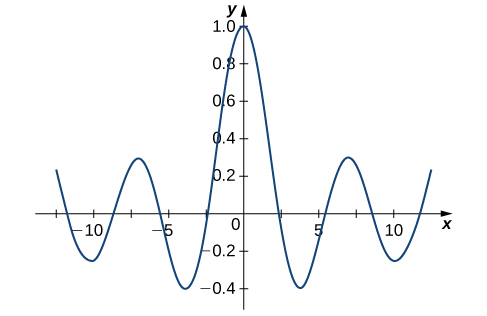
Find a power series solution to the Bessel equation of order 0 and graph the solution.

Solution

The Bessel equation of order 0 is given by

x 2 y ″ + x y ′ + x 2 y = 0 . x 2 y ″ + x y ′ + x 2 y = 0 .

We assume a solution of the form y=∑n=0∞anxn.y=∑n=0∞anxn. Then y′(x)=∑n=1∞nanxn−1y′(x)=∑n=1∞nanxn−1 and y″(x)=∑n=2∞n(n−1)anxn−2.y″(x)=∑n=2∞n(n−1)anxn−2. Substituting this into the differential equation, we get

x 2 ∑ n = 2 ∞ n ( n − 1 ) a n x n − 2 + x ∑ n = 1 ∞ n a n x n − 1 + x 2 ∑ n = 0 ∞ a n x n = 0 Substitution. ∑ n = 2 ∞ n ( n − 1 ) a n x n + ∑ n = 1 ∞ n a n x n + ∑ n = 0 ∞ a n x n + 2 = 0 Bring external factors within sums. ∑ n = 2 ∞ n ( n − 1 ) a n x n + ∑ n = 1 ∞ n a n x n + ∑ n = 2 ∞ a n − 2 x n = 0 Re-index third sum. ∑ n = 2 ∞ n ( n − 1 ) a n x n + a 1 x + ∑ n = 2 ∞ n a n x n + ∑ n = 2 ∞ a n − 2 x n = 0 Separate n = 1 term from second sum. a 1 x + ∑ n = 2 ∞ [ n ( n − 1 ) a n + n a n + a n − 2 ] x n = 0 Collect summation terms. a 1 x + ∑ n = 2 ∞ [ ( n 2 − n ) a n + n a n + a n − 2 ] x n = 0 Multiply through in first term. a 1 x + ∑ n = 2 ∞ [ n 2 a n + a n − 2 ] x n = 0. Simplify. x 2 ∑ n = 2 ∞ n ( n − 1 ) a n x n − 2 + x ∑ n = 1 ∞ n a n x n − 1 + x 2 ∑ n = 0 ∞ a n x n = 0 Substitution. ∑ n = 2 ∞ n ( n − 1 ) a n x n + ∑ n = 1 ∞ n a n x n + ∑ n = 0 ∞ a n x n + 2 = 0 Bring external factors within sums. ∑ n = 2 ∞ n ( n − 1 ) a n x n + ∑ n = 1 ∞ n a n x n + ∑ n = 2 ∞ a n − 2 x n = 0 Re-index third sum. ∑ n = 2 ∞ n ( n − 1 ) a n x n + a 1 x + ∑ n = 2 ∞ n a n x n + ∑ n = 2 ∞ a n − 2 x n = 0 Separate n = 1 term from second sum. a 1 x + ∑ n = 2 ∞ [ n ( n − 1 ) a n + n a n + a n − 2 ] x n = 0 Collect summation terms. a 1 x + ∑ n = 2 ∞ [ ( n 2 − n ) a n + n a n + a n − 2 ] x n = 0 Multiply through in first term. a 1 x + ∑ n = 2 ∞ [ n 2 a n + a n − 2 ] x n = 0. Simplify.

Then, a1=0,a1=0, and for n≥2,n≥2,

n 2 a n + a n − 2 = 0 a n = − 1 n 2 a n − 2 . n 2 a n + a n − 2 = 0 a n = − 1 n 2 a n − 2 .

Because a1=0,a1=0, all odd terms are zero. Then, for even values of n, we have

a 2 = − 1 2 2 a 0 a 4 = − 1 4 2 a 2 = 1 4 2 ⋅ 2 2 a 0 . a 6 = − 1 6 2 a 4 = − 1 6 2 ⋅ 4 2 ⋅ 2 2 a 0 a 2 = − 1 2 2 a 0 a 4 = − 1 4 2 a 2 = 1 4 2 ⋅ 2 2 a 0 . a 6 = − 1 6 2 a 4 = − 1 6 2 ⋅ 4 2 ⋅ 2 2 a 0

In general,

a 2 k = ( −1 ) k ( 2 ) 2 k ( k ! ) 2 a 0 . a 2 k = ( −1 ) k ( 2 ) 2 k ( k ! ) 2 a 0 .

Thus, we have

y ( x ) = a 0 ∑ k = 0 ∞ ( −1 ) k ( 2 ) 2 k ( k ! ) 2 x 2 k . y ( x ) = a 0 ∑ k = 0 ∞ ( −1 ) k ( 2 ) 2 k ( k ! ) 2 x 2 k .
(7.10)

The graph appears below for a0=1a0=1.

This figure is the graph of a function. The graph is oscillating with the highest amplitude above the origin. The horizontal axis is labeled in increments of 2.5. The vertical axis is labeled in increments of 0.2.

Checkpoint 7.23

Verify that the expression found in Example 7.26 is a solution to the Bessel equation of order 0.

Section 7.4 Exercises

Find a power series solution for the following differential equations.

104.

y ″ + 6 y ′ = 0 y ″ + 6 y ′ = 0

105.

5 y ″ + y ′ = 0 5 y ″ + y ′ = 0

106.

y ″ + 25 y = 0 y ″ + 25 y = 0

107.

y ″ − y = 0 y ″ − y = 0

108.

2 y ′ + y = 0 2 y ′ + y = 0

109.

y ′ − 2 x y = 0 y ′ − 2 x y = 0

110.

( x − 7 ) y ′ + 2 y = 0 ( x − 7 ) y ′ + 2 y = 0

111.

y ″ − x y ′ − y = 0 y ″ − x y ′ − y = 0

112.

( 1 + x 2 ) y ″ − 4 x y ′ + 6 y = 0 ( 1 + x 2 ) y ″ − 4 x y ′ + 6 y = 0

113.

x 2 y ″ − x y ′ − 3 y = 0 x 2 y ″ − x y ′ − 3 y = 0

114.

y ″ − 8 y ′ = 0 , y ( 0 ) = −2 , y ′ ( 0 ) = 10 y ″ − 8 y ′ = 0 , y ( 0 ) = −2 , y ′ ( 0 ) = 10

115.

y ″ − 2 x y = 0 , y ( 0 ) = 1 , y ′ ( 0 ) = −3 y ″ − 2 x y = 0 , y ( 0 ) = 1 , y ′ ( 0 ) = −3

116.

The differential equation x2y″+xy′+(x2−1)y=0x2y″+xy′+(x2−1)y=0 is a Bessel equation of order 1. Use a power series of the form y=∑n=0∞anxny=∑n=0∞anxn to find the solution.