Chapter 5

Chapter 5

Problems & Exercises

1.

5.00 N 5.00 N

4.

(a) 588 N

(b) 1.96 m/s21.96 m/s2

6.

(a) 3.29 m/s2

(b) 3.52 m/s2

(c) 980 N; 945 N

10.

1 . 83 m/s 2 1 . 83 m/s 2

14.

(a) 4.20 m/s24.20 m/s2

(b) 2.74 m/s22.74 m/s2

(c) –0.195 m/s2–0.195 m/s2

16.

(a) 1.03×10⁶N1.03×106N

(b) 3.48×10⁵N3.48×105N

18.

(a) 51.0 N51.0 N

(b) 0.720 m/s20.720 m/s2

20.

115 m/s; 414 km/hr 115 m/s; 414 km/hr

22.

25.1 m/s; 9.90 m/s 25.1 m/s; 9.90 m/s

24.

2 . 9 2 . 9

26.
η = F s r v = kg ⋅ m/s 2 m ⋅ m/s = kg m ⋅ s η = F s r v = kg ⋅ m/s 2 m ⋅ m/s = kg m ⋅ s
28.

0 . 76 kg/m ⋅ s 0 . 76 kg/m ⋅ s

29.
1 . 90 × 10 − 3 cm 1 . 90 × 10 − 3 cm
31.

(a)1 mm
(b) This does seem reasonable, since the lead does seem to shrink a little when you push on it.

33.

(a)9 cm
(b)This seems reasonable for nylon climbing rope, since it is not supposed to stretch that much.

35.

8.59 mm

37.
1 . 49 × 10 − 7 m 1 . 49 × 10 − 7 m
39.

(a) 3.99×10⁻⁷m3.99×10−7m

(b) 9.67×10⁻⁸m9.67×10−8m

41.

4×10⁶N/m24×106N/m2. This is about 36 atm, greater than a typical jar can withstand.

43.

1.4 cm

45.

(a) Bead A has the larger radius because both have the same weight and drag force. Since A takes longer to fall, its speed is less and, therefore, it must have larger area or radius.

(b) i. This equation is not consistent because it shows that the bead that took longer to fall has a smaller radius. ii. It does not make sense because r is proportional to t.
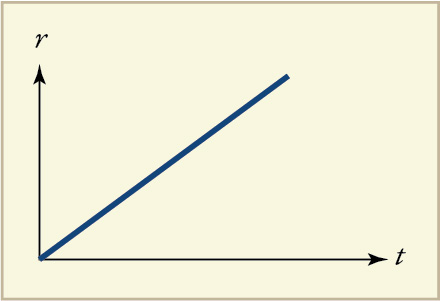
(c)

The figure is a plot of r as a function of t. The plot is a straight line through the origin with a positive slope.
Figure 5.23

Test Prep for AP® Courses

1.

(b)

3.

(c)