(a) 480 m480 m
(b) 379 m379 m, 18.4º18.4º east of north
north component 3.21 km, east component 3.83 km
19.5 m19.5 m, 4.65º4.65º south of west
(a) 26.6 m26.6 m, 65.1º65.1º north of east
(b) 26.6 m26.6 m, 65.1º65.1º south of west
52.9 m52.9 m, 90.1º90.1º with respect to the x-axis.
x-component 4.41 m/s
y-component 5.07 m/s
(a) 1.56 km
(b) 120 m east
North-component 87.0 km, east-component 87.0 km
30.8 m, 35.8 west of north
(a) 30.8 m30.8 m, 54.2º54.2º south of west
(b) 30.8 m30.8 m, 54.2º54.2º north of east
18.4 km south, then 26.2 km west(b) 31.5 km at 45.0º45.0º south of west, then 5.56 km at 45.0º45.0º west of north
7.34 km7.34 km, 63.5º63.5º south of east
x = 1.30 m×102 y = 30.9 m. x = 1.30 m×102 y = 30.9 m.
(a) 3.50 s
(b) 28.6 m/s (c) 34.3 m/s
(d) 44.7 m/s, 50.2º50.2º below horizontal
(a) 18.4º18.4º
(b) The arrow will go over the branch.
R=v02 sin 2θ 0 g Forθ=45º, R= v02g R=v02 sin 2θ 0 g Forθ=45º, R= v02g
R=91.8 mR=91.8 m for v0=30 m/sv0=30 m/s; R=163 mR=163 m for v0=40 m/sv0=40 m/s; R=255mR=255m for v0=50 m/sv0=50 m/s.
(a) 560 m/s
(b) 8.00 × 10³ m8.00 × 103 m
(c) 80.0 m. This error is not significant because it is only 1% of the answer in part (b).
1.50 m, assuming launch angle of 45º45º
θ = 6.1º θ = 6.1º
yes, the ball lands at 5.3 m from the net
(a) −0.486 m
(b) The larger the muzzle velocity, the smaller the deviation in the vertical direction, because the time of flight would be smaller. Air resistance would have the effect of decreasing the time of flight, therefore increasing the vertical deviation.
4.23 m. No, the owl is not lucky; he misses the nest.
No, the maximum range (neglecting air resistance) is about 92 m.
15.0 m/s
(a) 24.2 m/s
(b) The ball travels a total of 57.4 m with the brief gust of wind.
y−y0=0=v0yt−12gt2=( v0sinθ)t−12gt2y−y0=0=v0yt−12gt2=( v0sinθ)t−12gt2,
so that t=2(v0 sin θ)gt=2(v0 sin θ)g
x−x0=v0xt=(v0 cos θ)t=R,x−x0=v0xt=(v0 cos θ)t=R, and substituting for tt gives:
R = v 0 cos θ 2 v 0 sin θ g = 2 v 0 2 sin θ cos θ g R = v 0 cos θ 2 v 0 sin θ g = 2 v 0 2 sin θ cos θ g
since 2sinθcosθ=sin2θ,2sinθcosθ=sin2θ, the range is:
R= v 0 2 sin2θgR= v 0 2 sin2θg.
(a) 35.8 km35.8 km, 45º45º south of east
(b) 5.53 m/s5.53 m/s, 45º45º south of east
(c) 56.1 km56.1 km, 45º45º south of east
(a) 0.70 m/s faster
(b) Second runner wins
(c) 4.17 m
17.0 m/s17.0 m/s, 22.1º22.1º
(a) 230 m/s230 m/s, 8.0º8.0º south of west
(b) The wind should make the plane travel slower and more to the south, which is what was calculated.
(a) 63.5 m/s
(b) 29.6 m/s
6.68 m/s6.68 m/s, 53.3º53.3º south of west
(a) H average = 14 . 9 km/s Mly H average = 14 . 9 km/s Mly
(b) 20.2 billion years
1.72 m/s1.72 m/s, 42.3º42.3º north of east
(a) Since sin 2 50> sin 2 40 sin 2 50> sin 2 40, then B reaches the greatest height.
(b) i. Yes, it is consistent because sin50>sin40 sin50>sin40. ii. No, it does not make sense because y is proportional to sin 2 θ sin 2 θ.
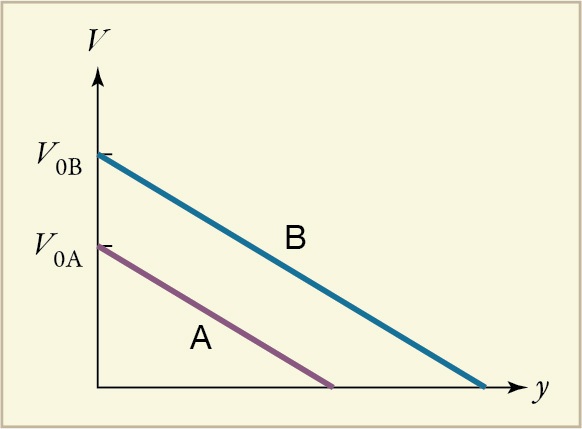
(c)